Way of St James walking tours: Walk the entire length of the French Way of St James from Le Puy en Velay to St Jean Pied de Port on this self guided walking trip
At a glance
Duration
40 days
Route
→
Countries
France
Activity level
moderate
Style
Trekking & Hiking
Group size
Ask
Flights
Not included
Solo travellers
Ask an agent
Day by day
Your journey through
France
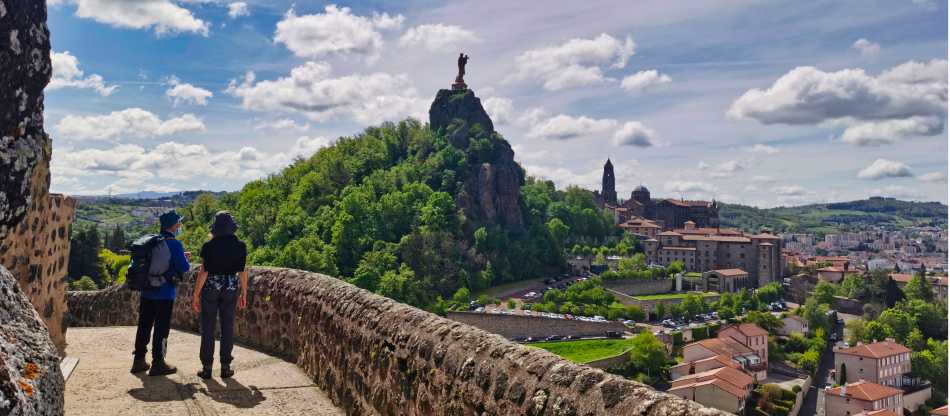
Day 1Day 1: Arrive Le Puy-en-VelayMake your own way to le Puy-en-Velay and the joining hotel. It is an ancient town surrounded by a volcanic landscape, dominated by rocky peaks rising from the valley floor. We recommend that you allow at least half a day to explore. Take a stroll through town and warm up your walking legs climbing the 267 steps to the Chapel of St Michael d'Aiguilhe, built by Godescalc after his pilgrimage to Santiago in AD951, for views over the town and surrounding area.You can also visit some of the many museums and the Romanesque Cathedral of Notre-Dame.
Make your own way to le Puy-en-Velay and the joining hotel. It is an ancient town surrounded by a volcanic landscape, dominated by rocky peaks rising from the valley floor. We recommend that you allow at least half a day to explore. Take a stroll through town and warm up your walking legs climbing the 267 steps to the Chapel of St Michael d'Aiguilhe, built by Godescalc after his pilgrimage to Santiago in AD951, for views over the town and surrounding area.You can also visit some of the many museums and the Romanesque Cathedral of Notre-Dame.
Day 2Day 2: Walk to Saint-Privat-d'Allier (5-6hrs)The cathedral at Le Puy is the starting point for your walk. As you follow the trail, there are great views over the whole area. Through rural landscapes you'll ascend rapidly from the Puy Basin. Crossing the Velay Mountains past fields of the famous green lentils, you enter the heart of the volcanic chain of the Deves before arriving in the small village of Saint Privat d’Allier and your gite. Distance 23km/14.3mi, +572m/1877ft, -390m/1280ft
The cathedral at Le Puy is the starting point for your walk. As you follow the trail, there are great views over the whole area. Through rural landscapes you'll ascend rapidly from the Puy Basin. Crossing the Velay Mountains past fields of the famous green lentils, you enter the heart of the volcanic chain of the Deves before arriving in the small village of Saint Privat d’Allier and your gite. Distance 23km/14.3mi, +572m/1877ft, -390m/1280ft
Day 3Day 3: Descend the gorges of Allier to Saugues (4-5hrs)A shorter but more challenging stage with ascents and descents, and very rewarding as there are wonderful views of the Velay Massif. The trail takes you to picturesque villages and hamlets such as Rochegude and Combriaux. From Monistrol on, the climb is quite steep to reach Montaure (1022m) on the edge of the Gevaudan plateau (up some 420m!). To Montaure the walk follows the ancient pilgrim’s trail precisely then leads you along a pleasant trail to arrive in Saugues, where you will stay for the night. Saugues is famous for its mushrooms, wooden shoes and as a meeting point for all pilgrims coming from the Auvergne. Distance 19km/11.9mi, +791m/2595ft, -694m/2277ft
A shorter but more challenging stage with ascents and descents, and very rewarding as there are wonderful views of the Velay Massif. The trail takes you to picturesque villages and hamlets such as Rochegude and Combriaux. From Monistrol on, the climb is quite steep to reach Montaure (1022m) on the edge of the Gevaudan plateau (up some 420m!). To Montaure the walk follows the ancient pilgrim’s trail precisely then leads you along a pleasant trail to arrive in Saugues, where you will stay for the night. Saugues is famous for its mushrooms, wooden shoes and as a meeting point for all pilgrims coming from the Auvergne. Distance 19km/11.9mi, +791m/2595ft, -694m/2277ft
Day 4Day 4: Cross the Margeride plateau to Les Faux or St Alban (7-8hrs)Today is very picturesque as you cross the Margeride Plateau. With vast grassy plains and moors of broom and heather, this part of the trail though long is relatively easy going, gently ascending most of the day. Interesting sights along the way include St Roch Chapel or L’Hospitalet du Dauvage Chapel, founded in 1198 as a hospital for pilgrims and travellers. Farm cafes along the way may be open however we suggest stocking up on snacks before leaving Saugues. Overnight is usually in Les Faux or at times, subject to availability, further along at St Alban sur Limagnole. Distance to Les Faux: 28km/17mi, +-620m/2034ft Distance to St Alban: 32km/20.25mi,+716m/2350ft, -829m/2404ft Option: It's possible to split this stage and stay overnight in Chanaleilles (vicinity) and continue to Les Faux/St Alban the following day. A supplement applies, please ask our team and this must be requested at time of booking. Accommodation either at 2 Pelerins (some twin rooms have private facilities, usually it's dormitory single bed accommodation and shared bathrooms - distance 11.5km/7.2mi) or Le Sauvage (dormitory single bed accommodation and shared bathrooms - distance 19.5km/12.2mi) - dependent on availability.
Today is very picturesque as you cross the Margeride Plateau. With vast grassy plains and moors of broom and heather, this part of the trail though long is relatively easy going, gently ascending most of the day. Interesting sights along the way include St Roch Chapel or L’Hospitalet du Dauvage Chapel, founded in 1198 as a hospital for pilgrims and travellers. Farm cafes along the way may be open however we suggest stocking up on snacks before leaving Saugues. Overnight is usually in Les Faux or at times, subject to availability, further along at St Alban sur Limagnole. Distance to Les Faux: 28km/17mi, +-620m/2034ft Distance to St Alban: 32km/20.25mi,+716m/2350ft, -829m/2404ft Option: It's possible to split this stage and stay overnight in Chanaleilles (vicinity) and continue to Les Faux/St Alban the following day. A supplement applies, please ask our team and this must be requested at time of booking. Accommodation either at 2 Pelerins (some twin rooms have private facilities, usually it's dormitory single bed accommodation and shared bathrooms - distance 11.5km/7.2mi) or Le Sauvage (dormitory single bed accommodation and shared bathrooms - distance 19.5km/12.2mi) - dependent on availability.
Day 5Day 5: Descend into the Truyère valley…From Les Faux the trail continues to the town of St Alban then descends into the Truyere valley. It's a bucolic day, taking you across small rivers, through forests, by fields and into small villages, as you traverse the vast plain of the Margeride. On the way, admire the Roman church of the Estrets, reworked several times and surmounted by a bell tower wall with three openings supporting a small steeple. Continue to Aumont and your accommodation. Distance from Les Faux: 21km/13mi, +383m/1256ft, -292m/964ft Distance from Saint Alban: 16km/10mi
From Les Faux the trail continues to the town of St Alban then descends into the Truyere valley. It's a bucolic day, taking you across small rivers, through forests, by fields and into small villages, as you traverse the vast plain of the Margeride. On the way, admire the Roman church of the Estrets, reworked several times and surmounted by a bell tower wall with three openings supporting a small steeple. Continue to Aumont and your accommodation. Distance from Les Faux: 21km/13mi, +383m/1256ft, -292m/964ft Distance from Saint Alban: 16km/10mi
Day 6Day 6: Walk to Nasbinals (7hrs)From Aumont-Aubrac in “Terre de Peyre” (land of stone), the trail crosses beautiful pine forests before joining the Aubrac plateau, an expanse of pastures punctuated by “burons” (traditionally a shelter in the Auvergne region where cheese was made). Here you are in the country of the famous Laguiole knife, an indispensable tool to cut the cheese of the same name. Arrive at your hotel/guest house in Nasbinals. Distance 26km/16.2mi, +392m/1286ft, -264m/866ft (highest point approx 1250m)
From Aumont-Aubrac in “Terre de Peyre” (land of stone), the trail crosses beautiful pine forests before joining the Aubrac plateau, an expanse of pastures punctuated by “burons” (traditionally a shelter in the Auvergne region where cheese was made). Here you are in the country of the famous Laguiole knife, an indispensable tool to cut the cheese of the same name. Arrive at your hotel/guest house in Nasbinals. Distance 26km/16.2mi, +392m/1286ft, -264m/866ft (highest point approx 1250m)
Day 7Day 7: To St-Chely-d'Aubrac (4-5hrs)This stage takes you through the heart of the Aubrac plateau, where the ancestral rite of transhumance is still practiced (the transhumance fair is on the Sunday nearest 25 May). For lunch you can try a regional specialty at a buron, where local dishes are available such as “aligot” (mashed potato with cheese and garlic), assorted meats from the mountains or a good crepe omelette. In Aubrac you can see remnants of an ancient “Domerie” (name given to the hospital in Aubrac in medieval times). Overnight hotel in St-Chely d'Aubrac. Distance 16km/10mi, +207m/679ft, -583m/1912ft (highest point approx 1360m)
This stage takes you through the heart of the Aubrac plateau, where the ancestral rite of transhumance is still practiced (the transhumance fair is on the Sunday nearest 25 May). For lunch you can try a regional specialty at a buron, where local dishes are available such as “aligot” (mashed potato with cheese and garlic), assorted meats from the mountains or a good crepe omelette. In Aubrac you can see remnants of an ancient “Domerie” (name given to the hospital in Aubrac in medieval times). Overnight hotel in St-Chely d'Aubrac. Distance 16km/10mi, +207m/679ft, -583m/1912ft (highest point approx 1360m)
Day 8Day 8: Continue to St Come d'Olt or Espalion (4.5-5hrs)Today you leave the country of the “Boraldes” (name given to the brooks descending from the Aubrac) to reach the Lot valley. Here you are near St-Côme d’Olt, listed among the “most beautiful villages of France”. There are remnants of numerous bridges constructed over the Lot river which made the pilgrims' crossings easier. Continue to St-Come d'Olt, where the usual accommodation has a pool. Distance 16.5km/10/3mi, +248m/814ft, -702m/2303ft (highest point approx 920m) Subject to availability you may stay at Espalion further along the trail. Espalion has a lovely old stone bridge over the River Lot, the Pont Vieux, listed as a UNESCO World Heritage Site. It has a lovely river front: the buildings with characteristic wooden balconies were once tanneries. The Friday morning market is reputed to be one of the best in the area. Distance 21.5km/13.4mi, +330m/1082ft, -715m/2345ft
Today you leave the country of the “Boraldes” (name given to the brooks descending from the Aubrac) to reach the Lot valley. Here you are near St-Côme d’Olt, listed among the “most beautiful villages of France”. There are remnants of numerous bridges constructed over the Lot river which made the pilgrims' crossings easier. Continue to St-Come d'Olt, where the usual accommodation has a pool. Distance 16.5km/10/3mi, +248m/814ft, -702m/2303ft (highest point approx 920m) Subject to availability you may stay at Espalion further along the trail. Espalion has a lovely old stone bridge over the River Lot, the Pont Vieux, listed as a UNESCO World Heritage Site. It has a lovely river front: the buildings with characteristic wooden balconies were once tanneries. The Friday morning market is reputed to be one of the best in the area. Distance 21.5km/13.4mi, +330m/1082ft, -715m/2345ft
Day 9Day 9: Follow the Lot river to Estaing (3-4hrs)Continue your walk following the Lot river to the lovely village of Estaing, with its Gothic bridge and imposing chateau. There is one short, quite steep ascent at around the 4km point. The annual St Fleuret fair has been held in Estaing since the 14th century (on the first Sunday in July). On this occasion, a great procession travels through the village in period costume. Overnight hotel in Estaing. Distance from Saint-Côme d'Olt 20km/12mi, +500m/1640ft, -559m/1834ft (highest point approx 490m) Distance from Espalion 12km/7.5mi, +210m/689ft, -255m/837ft
Continue your walk following the Lot river to the lovely village of Estaing, with its Gothic bridge and imposing chateau. There is one short, quite steep ascent at around the 4km point. The annual St Fleuret fair has been held in Estaing since the 14th century (on the first Sunday in July). On this occasion, a great procession travels through the village in period costume. Overnight hotel in Estaing. Distance from Saint-Côme d'Olt 20km/12mi, +500m/1640ft, -559m/1834ft (highest point approx 490m) Distance from Espalion 12km/7.5mi, +210m/689ft, -255m/837ft
Day 10Day 10: Continue to Golinhac (3.5hrs)Today is a straightforward walk, the last stage in the Lot valley. An ascent (approx 330m) is completed early on so you can enjoy the views across the hills as you walk along the plateau to Golinhac. Golinhac is remarkable for its church, which preserves the Roman foundations of a Benedictine priory, once dependent on Conques abbey. At the southern entrance of the village of Golinhac there is a stony cross with a small sculpted pilgrim. Overnight in Golinhac. Distance 14km/8.8mi, +512m/1680ft, -183m/600ft (highest point approx 660m)
Today is a straightforward walk, the last stage in the Lot valley. An ascent (approx 330m) is completed early on so you can enjoy the views across the hills as you walk along the plateau to Golinhac. Golinhac is remarkable for its church, which preserves the Roman foundations of a Benedictine priory, once dependent on Conques abbey. At the southern entrance of the village of Golinhac there is a stony cross with a small sculpted pilgrim. Overnight in Golinhac. Distance 14km/8.8mi, +512m/1680ft, -183m/600ft (highest point approx 660m)
Day 11Day 11: To Conques (6hrs)From Golinhac you will soon reach Espeyrac where in 960, according to the tale, a pilgrim who became blind after a mugging, recovered sight by making an invocation to the patron saint of Conques. The trail crosses the Daze and Tayrac, minor rivers, and Senergues with its fortified chateau and beautiful little church, then climbs onto the rolling plateau of Campeux, leading you to one of the most notable places on the Way of St James, the town of Conques. The walk into Conques is very often a favourite for pilgrims, as the view over the village is breathtaking if you come from the east. While descending into the deep valley of the Ouche, you will arrive near the Dourdou river (which flows into the Lot river, to the north) and discover this village where the towers of the Sainte-Foy abbey-church dominate. Its tympanum of the Last Judgment is a true Romanesque art piece. Relax in one of the many bars to experience the atmosphere of this lovely town. Distance 21km/13mi, +373m/1224ft, -757m/2483ft (highest point approx 670m) Please note: if you arrive in Conques on a Monday, the restaurant is closed and dinner is included on your rest day tomorrow.
From Golinhac you will soon reach Espeyrac where in 960, according to the tale, a pilgrim who became blind after a mugging, recovered sight by making an invocation to the patron saint of Conques. The trail crosses the Daze and Tayrac, minor rivers, and Senergues with its fortified chateau and beautiful little church, then climbs onto the rolling plateau of Campeux, leading you to one of the most notable places on the Way of St James, the town of Conques. The walk into Conques is very often a favourite for pilgrims, as the view over the village is breathtaking if you come from the east. While descending into the deep valley of the Ouche, you will arrive near the Dourdou river (which flows into the Lot river, to the north) and discover this village where the towers of the Sainte-Foy abbey-church dominate. Its tympanum of the Last Judgment is a true Romanesque art piece. Relax in one of the many bars to experience the atmosphere of this lovely town. Distance 21km/13mi, +373m/1224ft, -757m/2483ft (highest point approx 670m) Please note: if you arrive in Conques on a Monday, the restaurant is closed and dinner is included on your rest day tomorrow.
Day 12Day 12: Rest day in ConquesConques is picturesque, nestled in lush greenery. Enjoy exploring the medieval lanes of one of the "Most beautiful villages of France". At the Abbey-Church Sainte Foy, the Tympanum, is one of the world's most important examples of Romanesque sculpture, and don't miss 'Le Tresor' with its fine collections of medieval gold and jewels.
Conques is picturesque, nestled in lush greenery. Enjoy exploring the medieval lanes of one of the "Most beautiful villages of France". At the Abbey-Church Sainte Foy, the Tympanum, is one of the world's most important examples of Romanesque sculpture, and don't miss 'Le Tresor' with its fine collections of medieval gold and jewels.
Day 13Day 13: To Livinhac le Haut (6hrs)The trail this morning heads to the surrounding hills where the view over the village of Conques is striking. Along the way, visit a small chapel dedicated to Saint Roch, pilgrim saint of Montpellier. Here he is depicted as a pilgrim with a scallop shell. This evening your accommodation will be in Livinhac (near Decazeville) by the Lot river. Own dinner arrangements. Distance 24km/14.9mi, +671m/2201ft, -753m/2470ft
The trail this morning heads to the surrounding hills where the view over the village of Conques is striking. Along the way, visit a small chapel dedicated to Saint Roch, pilgrim saint of Montpellier. Here he is depicted as a pilgrim with a scallop shell. This evening your accommodation will be in Livinhac (near Decazeville) by the Lot river. Own dinner arrangements. Distance 24km/14.9mi, +671m/2201ft, -753m/2470ft
Day 14Day 14: Continue to Figeac (6-7hrs)Walking from Livinhac you will reach the hilltop village of Montredon, dominated by its church Saint Michel and Romanesque Chapel of St Mary. The route then crosses the countryside to arrive in Figeac. Figeac is a substantial medieval town in the Lot department, east of Cahors on the River Célé. It has an extensive and interesting historical centre, dating in part from the 9th century. There are also many houses and small palaces from the 13th to 16th centuries, when it was an important trade centre. It is the birthplace of Champollion, decipherer of the Egyptian hieroglyphs, and you can visit the excellent museum dedicated to his work. Own dinner arrangements. Distance 24km/14.9mi, +-507m/1663ft
Figeac (6-7hrs)
Walking from Livinhac you will reach the hilltop village of Montredon, dominated by its church Saint Michel and Romanesque Chapel of St Mary. The route then crosses the countryside to arrive in Figeac. Figeac is a substantial medieval town in the Lot department, east of Cahors on the River Célé. It has an extensive and interesting historical centre, dating in part from the 9th century. There are also many houses and small palaces from the 13th to 16th centuries, when it was an important trade centre. It is the birthplace of Champollion, decipherer of the Egyptian hieroglyphs, and you can visit the excellent museum dedicated to his work. Own dinner arrangements. Distance 24km/14.9mi, +-507m/1663ft
Day 15Day 15: Walk via Gréalou to Ussac - Saint-Chels (5hrs)The trail crosses the river Célé and ascends the limestone plateau where you can admire the magnificent "Cazels" or "Bories" - little drystone shepherd huts. Arrive in Gréalou, with its 12th century Romanesque church Our Lady of the Assumption then continue to rural accommodation in Ussac, Saint Chels. Distance 24.5km/15.3mi, +412m/1352ft, -231m/758ft Overnight may be in Grealou (subject to availability) where the accommodation has shared facilities. Distance to Grealou 20km/12.42mi
The trail crosses the river Célé and ascends the limestone plateau where you can admire the magnificent "Cazels" or "Bories" - little drystone shepherd huts. Arrive in Gréalou, with its 12th century Romanesque church Our Lady of the Assumption then continue to rural accommodation in Ussac, Saint Chels. Distance 24.5km/15.3mi, +412m/1352ft, -231m/758ft Overnight may be in Grealou (subject to availability) where the accommodation has shared facilities. Distance to Grealou 20km/12.42mi
Day 16Day 16: Continue to the pretty medieval town of Cajarc (4hrs)Today's walk is through forests and passes ancient dolmens (a type of megalithic tomb), stone shelters unique to the region and stone crosses, including the oldest on the whole route. Descend along the Lot valley to the small town of Cajarc in the heart of the valley, on a scenic stretch of the river as it passes through the Regional Natural Parc of the Causses de Quercy. Here you can visit the ruins of a castle dating from the 13th century and the chapel of St Margaret, listed as an historical monument since 1941. The site of the town has been occupied since the Roman period, with the fortified part of the village dating from the 12th century onwards, when the town prospered due to its port. Distance 11km/6.83mi, +109m/358ft, -338m/1108ft
Today's walk is through forests and passes ancient dolmens (a type of megalithic tomb), stone shelters unique to the region and stone crosses, including the oldest on the whole route. Descend along the Lot valley to the small town of Cajarc in the heart of the valley, on a scenic stretch of the river as it passes through the Regional Natural Parc of the Causses de Quercy. Here you can visit the ruins of a castle dating from the 13th century and the chapel of St Margaret, listed as an historical monument since 1941. The site of the town has been occupied since the Roman period, with the fortified part of the village dating from the 12th century onwards, when the town prospered due to its port. Distance 11km/6.83mi, +109m/358ft, -338m/1108ft
Day 17Day 17: To Limogne en Quercy (5hrs)Today’s walk takes you through lovely woods and the agricultural lands of the “Causses du Quercy”. “Les causses” means group of limestone plateaus in the Massif Central. It is quite an easy day’s walk, allowing you plenty of time to pace yourself, enjoy the walk and take in the lovely scenery. Limogne en Quercy is famous for its truffle fair, usually held on Sunday mornings from December to March and in summer. There is a Sunday market (also a Friday market in season). Distance 19km/11.9mi, +353m/1158ft, -203m/666ft
Today’s walk takes you through lovely woods and the agricultural lands of the “Causses du Quercy”. “Les causses” means group of limestone plateaus in the Massif Central. It is quite an easy day’s walk, allowing you plenty of time to pace yourself, enjoy the walk and take in the lovely scenery. Limogne en Quercy is famous for its truffle fair, usually held on Sunday mornings from December to March and in summer. There is a Sunday market (also a Friday market in season). Distance 19km/11.9mi, +353m/1158ft, -203m/666ft
Day 18Day 18: Walk to the truffle town of Lalbenque (6-7hrs)A great walk today as you continue across “le parc naturel regional des Causses de Quercy”. Along the way you'll see dolmens and other historic monuments and sights of interest: old windmills, wells, dry stone walls and a pretty monolithic cross (carved from a single block). The relative isolation of the plateau has created a quiet life for the villages, its farms and houses. If you get the chance, try the region’s most celebrated delicacy: the black truffle. Distance 22km/13.7mi, +230m/755ft, -385m/1263ft
A great walk today as you continue across “le parc naturel regional des Causses de Quercy”. Along the way you'll see dolmens and other historic monuments and sights of interest: old windmills, wells, dry stone walls and a pretty monolithic cross (carved from a single block). The relative isolation of the plateau has created a quiet life for the villages, its farms and houses. If you get the chance, try the region’s most celebrated delicacy: the black truffle. Distance 22km/13.7mi, +230m/755ft, -385m/1263ft
Day 19Day 19: Walk to Cahors (5hrs)Today's slightly undulating path runs through cultivated countryside and past several villages. You will pass many stone shepherd shelters, ‘caselles’, unique to the region. Walking into Cahors, you'll enjoy fantastic views. It's nestled in a meander of the Lot river and to arrive you cross the famous bridge Valentré, an emblem of the city and a well-known pilgrim milestone. Once a major financial and trading centre during the Middle Ages, Cahors' rich heritage is evident in its fine buildings. It's also know for wine, predominantly its AOC Cahors, an intense red. The region's wine making dates from Ancient Rome, with vines being planted in the area since around 50 BC. It is the largest city on the Le Puy Camino. On Saturday mornings, the market takes place at the foot of the Cathedral of Saint-Etienne, a listed historic monument. We suggest trying pastis, Cahors' famous pastry and apple cake. Distance 18km/11.2mi, +170m/558ft, -310m/1017ft
Today's slightly undulating path runs through cultivated countryside and past several villages. You will pass many stone shepherd shelters, ‘caselles’, unique to the region. Walking into Cahors, you'll enjoy fantastic views. It's nestled in a meander of the Lot river and to arrive you cross the famous bridge Valentré, an emblem of the city and a well-known pilgrim milestone. Once a major financial and trading centre during the Middle Ages, Cahors' rich heritage is evident in its fine buildings. It's also know for wine, predominantly its AOC Cahors, an intense red. The region's wine making dates from Ancient Rome, with vines being planted in the area since around 50 BC. It is the largest city on the Le Puy Camino. On Saturday mornings, the market takes place at the foot of the Cathedral of Saint-Etienne, a listed historic monument. We suggest trying pastis, Cahors' famous pastry and apple cake. Distance 18km/11.2mi, +170m/558ft, -310m/1017ft
Day 20Day 20: Walk to Lascabanes (6hrs)Leaving Cahors, the walk starts with a demanding climb, giving you a good view of the city and bridge down to the valley. You'll then continue to the Causses limestone plateau. You will pass Labastide-Marnhac before arriving in the little village of Lascabanes, where you'll find a lovely chapel. Lascabanes had a pilgrims' hospital in the 15th century and the tiny church still offers a pilgrim blessing daily at 6pm. Distance 23km/14.3mi, +414m/1358ft, -355m/1165ft
Leaving Cahors, the walk starts with a demanding climb, giving you a good view of the city and bridge down to the valley. You'll then continue to the Causses limestone plateau. You will pass Labastide-Marnhac before arriving in the little village of Lascabanes, where you'll find a lovely chapel. Lascabanes had a pilgrims' hospital in the 15th century and the tiny church still offers a pilgrim blessing daily at 6pm. Distance 23km/14.3mi, +414m/1358ft, -355m/1165ft
Day 21Day 21: On to Lauzerte (6hrs)The trail today leads you into the Tarn and Garonne region, with a few ascents and descents all the way. Walk through farmland and crop fields until you reach the beautiful village of Lauzerte, another of the “most beautiful villages of France”. This hilltop town is visible from miles away. It is in the heart of the AOC Chasselas de Moissac wine region and is also known for its Quercy melon production. Overnight Lauzerte. Distance 25km/15.5mi, +616m/2021ft, -593m/1945ft
The trail today leads you into the Tarn and Garonne region, with a few ascents and descents all the way. Walk through farmland and crop fields until you reach the beautiful village of Lauzerte, another of the “most beautiful villages of France”. This hilltop town is visible from miles away. It is in the heart of the AOC Chasselas de Moissac wine region and is also known for its Quercy melon production. Overnight Lauzerte. Distance 25km/15.5mi, +616m/2021ft, -593m/1945ft
Day 22Day 22: Walk to Moissac (7hrs)Today is a long but quite easy walking day on quiet countryside tracks, crossing woodlands, crop fields and vineyards. Pass by the village of Durfort, one of few in the region not to have a church. The vegetation after Durfort is lush with forests. Near the Tarn valley, orchards (apples, plums, pears, peaches, cherries, kiwis and melons) replace the vineyards. Moissac was formerly an important stop on the road to Santiago de Compostela for pilgrims coming from Geneva. Here you can visit the prestigious Abbey of Saint-Pierre with its UNESCO World Heritage cloister. Take a walk along the pont Canal de Cacor, a 356m canal bridge which allows the Garonne lateral canal to cross the Tarn river. Distance 28km/17.4mi, +469m/1538ft, -611m/2004ft
Today is a long but quite easy walking day on quiet countryside tracks, crossing woodlands, crop fields and vineyards. Pass by the village of Durfort, one of few in the region not to have a church. The vegetation after Durfort is lush with forests. Near the Tarn valley, orchards (apples, plums, pears, peaches, cherries, kiwis and melons) replace the vineyards. Moissac was formerly an important stop on the road to Santiago de Compostela for pilgrims coming from Geneva. Here you can visit the prestigious Abbey of Saint-Pierre with its UNESCO World Heritage cloister. Take a walk along the pont Canal de Cacor, a 356m canal bridge which allows the Garonne lateral canal to cross the Tarn river. Distance 28km/17.4mi, +469m/1538ft, -611m/2004ft
Day 23Day 23: To AuvillarLeaving Moissac, pass by its abbey and continue along the Tarn before returning to the Garonne and its lateral canal. You soon enter the Lomagne or "hunchback Gascogne", an area of natural beauty. Straddling the Tarn et Garonne and the Gers, this former dependency of the Duchy of Gascony is a land of white garlic, interesting houses and churches. Today's destination is the village of Auvillar, built on a promontory and classified as another of the "most beautiful villages in France". With its circular market built in 1824, its clock tower and old stone houses, there is much to see around the town. Distance 22km/13.5mi, +334m/1096ft, -300m/984ft
Leaving Moissac, pass by its abbey and continue along the Tarn before returning to the Garonne and its lateral canal. You soon enter the Lomagne or "hunchback Gascogne", an area of natural beauty. Straddling the Tarn et Garonne and the Gers, this former dependency of the Duchy of Gascony is a land of white garlic, interesting houses and churches. Today's destination is the village of Auvillar, built on a promontory and classified as another of the "most beautiful villages in France". With its circular market built in 1824, its clock tower and old stone houses, there is much to see around the town. Distance 22km/13.5mi, +334m/1096ft, -300m/984ft
Day 24Day 24: To Flamarens (4hrs)Today you will leave the Lot department and enter the farmlands of “Le Gers”. The walk takes you to the lovely village of Flamarens, with its castle built in the 13th century. Distance 14km/8.7mi, +364m/1194ft, -275m/902ft
Today you will leave the Lot department and enter the farmlands of “Le Gers”. The walk takes you to the lovely village of Flamarens, with its castle built in the 13th century. Distance 14km/8.7mi, +364m/1194ft, -275m/902ft
Day 25Day 25: Walk to Lectoure (6hrs)Today's walk takes you first to Miradoux, a former bastide founded in 1253, the oldest in the department. Built on a small promontory, the town has character-filled stone houses, evidence of the area's rich history. Further along the trail is your destination, the lovely town of Lectoure, built on a rocky outcrop high above the hills of Lomagne. This is the Armagnac región! Known as one of the oldest cities in the Gers, Lectoure's foundation dates back to the Gallo-Roman period. With its imposing Cathedral and Chateau, once home to the Counts of Armagnac, the town has a colourful history including the siege of Louis XI in 1473. If you are here on a Friday, there is a fabulous market in the morning that showcases the region's gastronomical delights - cheeses, olives, fresh vegetables and other wonderful local produce. Distance 19km/11.9mi, +274m/999ft, -299m/981ft
Today's walk takes you first to Miradoux, a former bastide founded in 1253, the oldest in the department. Built on a small promontory, the town has character-filled stone houses, evidence of the area's rich history. Further along the trail is your destination, the lovely town of Lectoure, built on a rocky outcrop high above the hills of Lomagne. This is the Armagnac región! Known as one of the oldest cities in the Gers, Lectoure's foundation dates back to the Gallo-Roman period. With its imposing Cathedral and Chateau, once home to the Counts of Armagnac, the town has a colourful history including the siege of Louis XI in 1473. If you are here on a Friday, there is a fabulous market in the morning that showcases the region's gastronomical delights - cheeses, olives, fresh vegetables and other wonderful local produce. Distance 19km/11.9mi, +274m/999ft, -299m/981ft
Day 26Day 26: Walk to La Romieu (5hrs)Leaving Lectoure and the Ger River behind, the trail takes you to Marsolan, where on the terrace of the remains of the old hospital Saint Jacques at the entrance to the village you can take in the impressive view of the Auchie Gascon Valley. Continuing through fields and woods, the trail descends gently to La Romieu, another of the 'most beautiful villages in France'. Here you can visit the 14th century Collegiate Church of St Pierre La Romieu whose towers resemble a castle and whose cloisters are a 'must-see'. It's also called the "village of cats" because of the many sculpted cats you'll see around town, the work of Maurice Serreau. Distance 18.5km/11.5mi, +300m/984ft, -301m/984ft
Leaving Lectoure and the Ger River behind, the trail takes you to Marsolan, where on the terrace of the remains of the old hospital Saint Jacques at the entrance to the village you can take in the impressive view of the Auchie Gascon Valley. Continuing through fields and woods, the trail descends gently to La Romieu, another of the 'most beautiful villages in France'. Here you can visit the 14th century Collegiate Church of St Pierre La Romieu whose towers resemble a castle and whose cloisters are a 'must-see'. It's also called the "village of cats" because of the many sculpted cats you'll see around town, the work of Maurice Serreau. Distance 18.5km/11.5mi, +300m/984ft, -301m/984ft
Day 27Day 27: Continue to the Armagnac town of Condom (4hrs)Leaving La Romieu the expansive views of the open countryside of the Gers are inspiring. It's an ideal walking environment, best before the midday sun sets in. The area represents the transition between the 'haute' Armagnac around Lectoure (also called White Armagnac due to the limestone found throughout the area), the 'bas' Armagnac around Eauze and the Armagnac 'Noir', where thick black oak woods are found and 57% of the wine crops of Armagnac are located. Condom is one of the principal Armagnac towns and is located at a spur of the rivers Gele and Baise. The key attraction is the Gothic styled cathedral of St Peter's, the last built in the Languedoc style. Distance 13km/8.1mi, +217m/712ft, -316m/1036ft
Leaving La Romieu the expansive views of the open countryside of the Gers are inspiring. It's an ideal walking environment, best before the midday sun sets in. The area represents the transition between the 'haute' Armagnac around Lectoure (also called White Armagnac due to the limestone found throughout the area), the 'bas' Armagnac around Eauze and the Armagnac 'Noir', where thick black oak woods are found and 57% of the wine crops of Armagnac are located. Condom is one of the principal Armagnac towns and is located at a spur of the rivers Gele and Baise. The key attraction is the Gothic styled cathedral of St Peter's, the last built in the Languedoc style. Distance 13km/8.1mi, +217m/712ft, -316m/1036ft
Day 28Day 28: Walk to Montréal du Gers…We recommend taking a 15 minute detour to visit the tiny fortified town of Larresingle, which was the fortress of the Bishops of Condom in the Middle Ages and another of the 'most beautiful villages in France', referred to by the locals as the "Carcassonne of Gers". Further along the way you pass the Pont d'Artigues, a Romanesque bridge over the Osse. Once the site of a pilgrim hospital and a church, there are no remains of these buildings today. A little further along you come across the Eglise de Routges, the oldest church in the region, before arriving at Montréal-du-Gers. This interesting bastide town, another of the “most beautiful villages of France”, was one of the first English fortified towns of Gascogne (1289). It has a central square surrounded by arcades, the 13th century Church of Ste Marie and historic houses. Distance 17km/10.5mi, +238m/780ft, -209m/685ft
We recommend taking a 15 minute detour to visit the tiny fortified town of Larresingle, which was the fortress of the Bishops of Condom in the Middle Ages and another of the 'most beautiful villages in France', referred to by the locals as the "Carcassonne of Gers". Further along the way you pass the Pont d'Artigues, a Romanesque bridge over the Osse. Once the site of a pilgrim hospital and a church, there are no remains of these buildings today. A little further along you come across the Eglise de Routges, the oldest church in the region, before arriving at Montréal-du-Gers. This interesting bastide town, another of the “most beautiful villages of France”, was one of the first English fortified towns of Gascogne (1289). It has a central square surrounded by arcades, the 13th century Church of Ste Marie and historic houses. Distance 17km/10.5mi, +238m/780ft, -209m/685ft
Day 29Day 29: To the Roman town of Eauze (5hrs)Most of the walking today is flat and across agricultural landscapes intersected by minor roads. The first 10km take you through vineyards and pretty countryside until you reach the hamlet of Lamothe. From here the trail heads down into the valley before a steady uphill takes you gently into the Place d’Armagnac in Eauze. In the third century AD, the city became the capital of the Roman province of Novempopulania. You will also find an archeology museum in the heart of Eauze, where you can discover the trails of the ancient city of Elusa. Other attractions include the Gothic cathedral, an Andalusian style bullring and numerous historic houses including 'la maison dite de Jeanne d'Albret. Own dinner arrangements. Distance 17km/10.6mi, +198m/650ft, -155m/508ft
Most of the walking today is flat and across agricultural landscapes intersected by minor roads. The first 10km take you through vineyards and pretty countryside until you reach the hamlet of Lamothe. From here the trail heads down into the valley before a steady uphill takes you gently into the Place d’Armagnac in Eauze. In the third century AD, the city became the capital of the Roman province of Novempopulania. You will also find an archeology museum in the heart of Eauze, where you can discover the trails of the ancient city of Elusa. Other attractions include the Gothic cathedral, an Andalusian style bullring and numerous historic houses including 'la maison dite de Jeanne d'Albret. Own dinner arrangements. Distance 17km/10.6mi, +198m/650ft, -155m/508ft
Day 30Day 30: Pass Armagnac vineyards and walnut groves to Nogaro (6hrs)Today, you will walk on a fairly flat trail through through the vineyards of Armagnac, walnut groves and open countryside. Along the way is the beautiful town of Manciet, an historic point on the Le Puy Camino. In the Middle Ages, pilgrims coming from Auch would meet those walking the Le Puy route. On the second Sunday in September a village fete is held here. Passing the church of St Jean Baptiste de la Commanderie de Saint Christie de l'Armagnac there are some small descents and ascents before the path leads into Nogaro. Its name is taken from Nogarium which means 'a place planted with walnuts'. The town has a bullring and a collegiate 12th Century Romanesque church. Distance 20km/12.4mi, +269m/882ft, -297m/974ft
Today, you will walk on a fairly flat trail through through the vineyards of Armagnac, walnut groves and open countryside. Along the way is the beautiful town of Manciet, an historic point on the Le Puy Camino. In the Middle Ages, pilgrims coming from Auch would meet those walking the Le Puy route. On the second Sunday in September a village fete is held here. Passing the church of St Jean Baptiste de la Commanderie de Saint Christie de l'Armagnac there are some small descents and ascents before the path leads into Nogaro. Its name is taken from Nogarium which means 'a place planted with walnuts'. The town has a bullring and a collegiate 12th Century Romanesque church. Distance 20km/12.4mi, +269m/882ft, -297m/974ft
Day 31Day 31: Walk to Aire sur l'Adour or Barcelonne du Gers (7.5hrs)Today you will mainly be walking alongside cereal crops and farmland, and passing some of the prettiest villages and hamlets on the entire route. On the last stretch vineyards become rarer and the landscape changes to tree-covered, with maritime pines, oaks and chestnuts. There is quite a bit of road walking but not much traffic, mainly tractors. Barcelonne du Gers and Aire sur l’Adour are neighbouring towns by the river Adour. Barcelonne-du-Gers is known for its AOC Saint-Mont wine and its architectural and historical heritage, which bears witness to a rich past. Aire sur l'Adour has a lower section by the river which is dominated by the St Jean Baptiste cathedral, and a high town or Mas d'Aire, which is dominated by the Eglise de Sainte Quitterie, where a Benedictine monastery once stood. Distance to Barcelonne 25km/15.6mi, +207m/679ft, -267m/875ft
Today you will mainly be walking alongside cereal crops and farmland, and passing some of the prettiest villages and hamlets on the entire route. On the last stretch vineyards become rarer and the landscape changes to tree-covered, with maritime pines, oaks and chestnuts. There is quite a bit of road walking but not much traffic, mainly tractors. Barcelonne du Gers and Aire sur l’Adour are neighbouring towns by the river Adour. Barcelonne-du-Gers is known for its AOC Saint-Mont wine and its architectural and historical heritage, which bears witness to a rich past. Aire sur l'Adour has a lower section by the river which is dominated by the St Jean Baptiste cathedral, and a high town or Mas d'Aire, which is dominated by the Eglise de Sainte Quitterie, where a Benedictine monastery once stood. Distance to Barcelonne 25km/15.6mi, +207m/679ft, -267m/875ft
Day 32Day 32: Walk to Miramont-Sensacq (4-5hrs)You'll wander through lush green countryside with hamlets and ancient buildings such as medieval chapels and wash-houses (“lavoirs”). The snow-capped Pyrenees come into view as you enter the Pyrenees-Atlantiques department. Pass the magnificent 11th century Church of Miramont Sensacq, formerly dedicated to St James. Overnight Miramont-Sensacq. Distance: 20km/12.5mi, +416m/1364ft, -253m/830ft
You'll wander through lush green countryside with hamlets and ancient buildings such as medieval chapels and wash-houses (“lavoirs”). The snow-capped Pyrenees come into view as you enter the Pyrenees-Atlantiques department. Pass the magnificent 11th century Church of Miramont Sensacq, formerly dedicated to St James. Overnight Miramont-Sensacq. Distance: 20km/12.5mi, +416m/1364ft, -253m/830ft
Day 33Day 33: Continue to Fichous-Riumayou (5-6hrs)Today the trail continues through the beautiful Béarn region. With the Pyrenees to the south, you'll cross rolling hills, pass the town of Arzacq Arraziguet, a bastide town built in the 11th century with two main squares and two “lavoirs, and many villages such as Louvigny. Distance 26km/16mi, +481m/1578ft, -437m/1433ft
Fichous-Riumayou (5-6hrs)
Today the trail continues through the beautiful Béarn region. With the Pyrenees to the south, you'll cross rolling hills, pass the town of Arzacq Arraziguet, a bastide town built in the 11th century with two main squares and two “lavoirs, and many villages such as Louvigny. Distance 26km/16mi, +481m/1578ft, -437m/1433ft
Day 34Day 34: On to Arthez-de-Béarn (5hrs)Today your walk takes you to Larreule with its Benedictine Monastery and then Uzan, where you can visit the beautiful rural church of Sainte Quitterie and a stone fountain. From Pomps you continue to Arthez-de-Béarn, with its distinctive Basque architecture. Stay tonight in Arthez-de-Béarn. Distance 19km/11.8mi, +230m/755ft, -271m/890ft
Today your walk takes you to Larreule with its Benedictine Monastery and then Uzan, where you can visit the beautiful rural church of Sainte Quitterie and a stone fountain. From Pomps you continue to Arthez-de-Béarn, with its distinctive Basque architecture. Stay tonight in Arthez-de-Béarn. Distance 19km/11.8mi, +230m/755ft, -271m/890ft
Day 35Day 35: Continue walk to to Sauvelade (4-5hrs)Today's stage takes you through woods and past churches and chapels before reaching the small village of Maslacq. Later the trail passes a sanctuary and former monastery, La Sauvelade. Distance: 20.5km/12.8mi, +361m/1184ft, -390m/1280ft
Today's stage takes you through woods and past churches and chapels before reaching the small village of Maslacq. Later the trail passes a sanctuary and former monastery, La Sauvelade. Distance: 20.5km/12.8mi, +361m/1184ft, -390m/1280ft
Day 36Day 36: Through fields and past small villages…The undulating trail takes you through quiet rural scenes to reach the town of Navarrenx, the first in France to be fortified with Italian style ramparts. Another great day's walk through the last of the Béarnais countyside on this route, crossing small streams and ascending fields and wooded trails. En route you pass a pâté producer (Jean Haget) and the Mongaston Castle, before reaching the small village of Lichos, the birthplace of Saint-Grat, Bishop of Oloron. You have now crossed over into the Basque region of France. Overnight in Aroue-Ithorots-Olhaïby. Please note our usual accommodation has a private shower however the other facilities are shared. Distance 30km/18.6mi, +431m/1414ft, -552m/1811ft Option: if the full distance to Aroue is too long, you can split today and stay overnight in Navarrenx. This must be requested at time of booking and a supplement applies. Distance to Navarrenx: 11km/6.88mi and from Navarrenx to Aroue: 19.50km/12.2mi.
The undulating trail takes you through quiet rural scenes to reach the town of Navarrenx, the first in France to be fortified with Italian style ramparts. Another great day's walk through the last of the Béarnais countyside on this route, crossing small streams and ascending fields and wooded trails. En route you pass a pâté producer (Jean Haget) and the Mongaston Castle, before reaching the small village of Lichos, the birthplace of Saint-Grat, Bishop of Oloron. You have now crossed over into the Basque region of France. Overnight in Aroue-Ithorots-Olhaïby. Please note our usual accommodation has a private shower however the other facilities are shared. Distance 30km/18.6mi, +431m/1414ft, -552m/1811ft Option: if the full distance to Aroue is too long, you can split today and stay overnight in Navarrenx. This must be requested at time of booking and a supplement applies. Distance to Navarrenx: 11km/6.88mi and from Navarrenx to Aroue: 19.50km/12.2mi.
Day 37Day 37: Walk to Saint Palais (6hrs)The walk today takes you via the Eglise d'Olhaiby along rural trails to Saint Palais, a cultural town which plays host to colourful festivals and markets. Here the street signs are in the Basque language which is typical of the region. This is also the entry point into the Lower Navarre, formerly the Kingdom of Navarre. There are a number of sights to visit including a museum containing historic pilgrim relics and a statue of St James the pilgrim. Be aware: the usual accommodation is a little off the GR65 (approx 4.5km north, included in today's distance). Note: dinner is not included tonight if your stay is on a Fri, Sat or Sun evening. Distance 26km/16.2mi, +370m/1213ft, -577m/1893ft
The walk today takes you via the Eglise d'Olhaiby along rural trails to Saint Palais, a cultural town which plays host to colourful festivals and markets. Here the street signs are in the Basque language which is typical of the region. This is also the entry point into the Lower Navarre, formerly the Kingdom of Navarre. There are a number of sights to visit including a museum containing historic pilgrim relics and a statue of St James the pilgrim. Be aware: the usual accommodation is a little off the GR65 (approx 4.5km north, included in today's distance). Note: dinner is not included tonight if your stay is on a Fri, Sat or Sun evening. Distance 26km/16.2mi, +370m/1213ft, -577m/1893ft
Day 38Day 38: To Ostabat-Asme (3hrs)During your walk today you will pass the Stelle de Gibraltar, where all the Camino routes from France meet. Continue across rolling countryside before reaching the chapel of Soyarce where you will get amazing views over the Pyrenees. Next you will reach the village of Ostabat-Asme, today a small village but an important stop for pilgrims in the Middle Ages. Dependent on availability, at times we use a hotel in Larceveau, 2km further along the trail. Distance 11km/6.8mi, +380m/1246ft, -397m/1302ft
During your walk today you will pass the Stelle de Gibraltar, where all the Camino routes from France meet. Continue across rolling countryside before reaching the chapel of Soyarce where you will get amazing views over the Pyrenees. Next you will reach the village of Ostabat-Asme, today a small village but an important stop for pilgrims in the Middle Ages. Dependent on availability, at times we use a hotel in Larceveau, 2km further along the trail. Distance 11km/6.8mi, +380m/1246ft, -397m/1302ft
Day 39Day 39: To Saint Jean Pied de Port (6hrs)Your last walking day! The trail leads you through the Basque countryside and along the D933, through the valley and on old paths either side of the road. En route you pass the sights of pilgrims' hospitals and the Croix de Galzetaburia at the crossing of Roman roads to mark the entry of secondary routes onto the Via Podiensis. Passing the villages of Mongelos and Bussanarits you reach Donazaharre with its church of St Pierre. Soon you'll enter the pretty pilgrimage town of St Jean Pied de Port via the Porte Saint-Jacques. At the foothills of the Pyrenees, it is a small border town but always busy with pilgrims, and traditionally an important point on the Camino. The routes from Paris, Vézelay and Le Puy-en-Velay meet at Saint-Jean, the last stop before the mountain crossing into Spain. Distance 22.5km/14mi, +397m/1302ft, -387m/1270ft (or 20km from Larceveau)
Your last walking day! The trail leads you through the Basque countryside and along the D933, through the valley and on old paths either side of the road. En route you pass the sights of pilgrims' hospitals and the Croix de Galzetaburia at the crossing of Roman roads to mark the entry of secondary routes onto the Via Podiensis. Passing the villages of Mongelos and Bussanarits you reach Donazaharre with its church of St Pierre. Soon you'll enter the pretty pilgrimage town of St Jean Pied de Port via the Porte Saint-Jacques. At the foothills of the Pyrenees, it is a small border town but always busy with pilgrims, and traditionally an important point on the Camino. The routes from Paris, Vézelay and Le Puy-en-Velay meet at Saint-Jean, the last stop before the mountain crossing into Spain. Distance 22.5km/14mi, +397m/1302ft, -387m/1270ft (or 20km from Larceveau)
Day 40Day 40: Trip concludesYour trip concludes after breakfast. We offer the Camino in Spain too, if you're keen to continue...
Your trip concludes after breakfast. We offer the Camino in Spain too, if you're keen to continue...