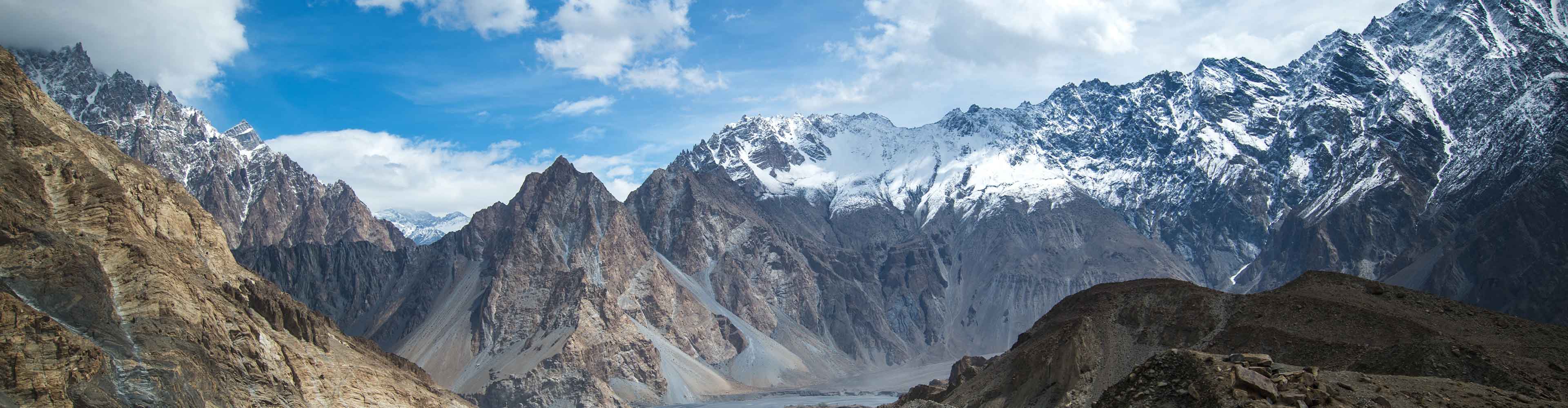
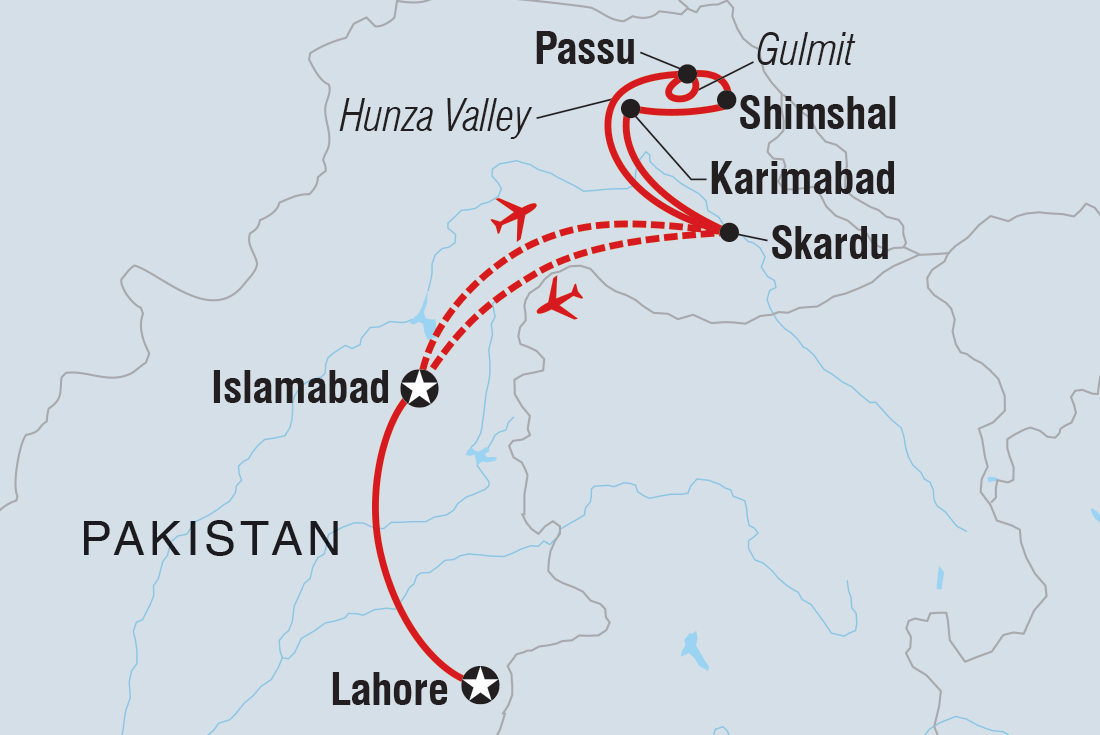
Get set for a 15-day expedition through an ancient land. Beginning in Pakistan’s capital of Islamabad, the expedition takes you north to the stunning and rarely visited Hunza Valley region. Here you’ll find nature unleashed: imagine imposing jagged peaks, alpine lakes and glaciers creeping into the valleys. Hike between ancient fortifications scattered among rural villages and learn about the modern innovations that help the local people prosper. Finish in Lahore, a city that not only stood strong through the rise and fall of empires but also preserved the culture that makes Pakistan such a mesmerising, all-consuming country.
◆Complimentary Arrival Transfer
◆Islamabad - Faisal Mosque at sunset
◆Islamabad - Taxila Museum & archeological sites
◆Islamabad - Truck art workshop
◆Skardu - Kharpocho Fort visit
◆Skardu - Manthal Buddha Rock
◆
Skardu - Skardu market visit
◆Skardu - Katpana Desert
◆Nagar Valley - Rakaposhi view point
◆Gulmit - Women-run carpet weaving center visit
◆Hunza Valley - Ondra Polygah hike
◆Gulmit - Old House Gulmit visit
◆Hunza Valley - Passu Glacier hike
◆Hunza Valley - Borith Lake hike
◆Hunza Valley - Hussaini Suspension Bridge
◆Shimshal - Village tour & optional hike
◆Hunza Valley - Sacred Rock of Hunza
◆Hunza Valley - Attabad Lake
◆Karimabad - Market tour
◆Hunza Valley - Ganish Village walking tour
◆Karimabad - Lunch at women-run cafe
◆Karimabad - Ciqam women's social enterprise visit
◆Karimabad - Baltit & Altit Forts
◆Karimabad - Duiker (Eagle's Nest) sunset viewing
◆Karimabad - Traditional music performance
◆Lahore - Anarkali & Liberty Markets
◆Lahore - Akbari Mandi & Azam Cloth Market
◆Lahore - Wazir Khan Mosque
◆Lahore - Shahi Hammam
◆Lahore - Walled City of Lahore
◆Lahore - Badshahi Mosque
◆Lahore - Tomb of Allama Iqbal
◆Lahore - Delhi Gate
◆Lahore - Lahore Fort
◆Lahore - Shalimar Gardens
◆Lahore - Wagah Border ceremony
◆Lahore - Tomb of Jahangir
◆Lahore - Dinner at Food Street
◆Complimentary Departure Transfer
At a glance
Duration
15 days
Route
Islamabad → Lahore
Countries
Pakistan
Activity level
active
Style
Culture & History, National Parks & Wilderness, Trekking & Hiking
Group size
Max 12
Ages
15+
Flights
Not included
Solo travellers
Welcome
Where you'll go
Day by day
Your journey through
Pakistan
Showing Days 1-7
15-day itinerary
Day 1IslamabadWelcome to Islamabad, Pakistan’s capital city. Translating as ‘City of Islam’, Islamabad was built in the 1960s to replace Karachi as the nation’s capital, though there’s evidence that humans have lived in the area for many thousands of years. Your expedition begins with a welcome meeting at 6 pm, but if you arrive earlier there are several sights worth checking out including Golra Railway Station, and the Lok Virsa Museum – dedicated to the preservation, documentation promotion of Pakistan’s cultural heritage. After your welcome meeting, get to know your group and local leader over an included dinner.
Islamabad
Welcome to Islamabad, Pakistan’s capital city. Translating as ‘City of Islam’, Islamabad was built in the 1960s to replace Karachi as the nation’s capital, though there’s evidence that humans have lived in the area for many thousands of years. Your expedition begins with a welcome meeting at 6 pm, but if you arrive earlier there are several sights worth checking out including Golra Railway Station, and the Lok Virsa Museum – dedicated to the preservation, documentation promotion of Pakistan’s cultural heritage. After your welcome meeting, get to know your group and local leader over an included dinner.
Day 2Islamabad - Taxila - IslamabadMake the most of the opportunity to explore Islamabad with your fellow travellers. Your local leader will speak with you about the history of both Islamabad and Pakistan and be able to answer any questions about this oft-misunderstood destination. There’ll be a chance to shop for local clothes, so perhaps take the opportunity to buy a shalwar kameez – the traditional dress of loose-fitting trousers and a long shirt. Visit Faisal Mosque, which was the largest mosque in the world upon its completion in 1986 and is said to hold 10,000 worshippers, then head to the ancient site of Taxila. These World Heritage-listed ruins are evidence of over 500 years of cultural evolution influenced by Persia, Greece, and the spread of Buddhism. Enjoy a group dinner at neraby Saidpur village.
Islamabad
Make the most of the opportunity to explore Islamabad with your fellow travellers. Your local leader will speak with you about the history of both Islamabad and Pakistan and be able to answer any questions about this oft-misunderstood destination. There’ll be a chance to shop for local clothes, so perhaps take the opportunity to buy a shalwar kameez – the traditional dress of loose-fitting trousers and a long shirt. Visit Faisal Mosque, which was the largest mosque in the world upon its completion in 1986 and is said to hold 10,000 worshippers, then head to the ancient site of Taxila. These World Heritage-listed ruins are evidence of over 500 years of cultural evolution influenced by Persia, Greece, and the spread of Buddhism. Enjoy a group dinner at neraby Saidpur village.
Day 3Islamabad - Skardu (2228m)Fly this morning from Islamabad to Skardu. Being the gateway to the Karakoram Mountain Range, it’s a popular spot for hikers and outdoorsy types, and your day will be spent exploring all that Skardu has to offer. You’ll head to the Skardu Bazaar, where you can pick up any snacks or souvenirs that might be calling your name. Then it’s on to the Manthal Rock Buddha – a sculpture dating back to the 8th century – as well as Kharpocho Fort.
Islamabad
Fly this morning from Islamabad to Skardu. Being the gateway to the Karakoram Mountain Range, it’s a popular spot for hikers and outdoorsy types, and your day will be spent exploring all that Skardu has to offer. You’ll head to the Skardu Bazaar, where you can pick up any snacks or souvenirs that might be calling your name. Then it’s on to the Manthal Rock Buddha – a sculpture dating back to the 8th century – as well as Kharpocho Fort.
Day 4Hunza Valley (2500m)Today, travel north to Passu, a small town surrounded by mountains and glaciers. It sits by the famous Karakoram Highway, which is also known as the China-Pakistan Friendship Highway as it connects the two countries. This is an achingly beautiful part of the world and there’ll be several opportunities to stop and take in views of many 7000 m peaks, including Rakaposhi. You’ll be staying in Passu for the next three nights, using it as your base for exploring the region.
Hunza Valley (2500m)
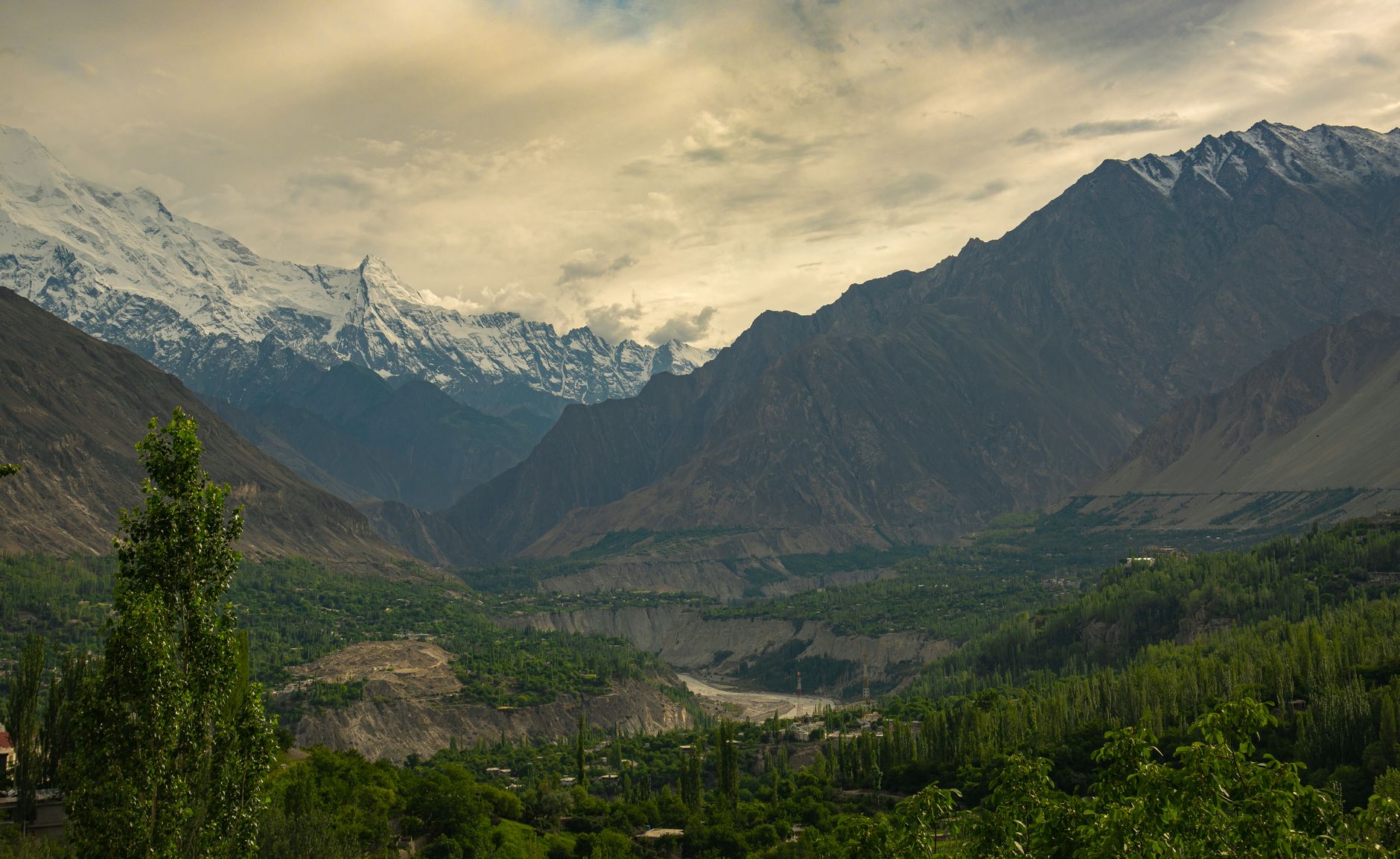
Today, travel north to Passu, a small town surrounded by mountains and glaciers. It sits by the famous Karakoram Highway, which is also known as the China-Pakistan Friendship Highway as it connects the two countries. This is an achingly beautiful part of the world and there’ll be several opportunities to stop and take in views of many 7000 m peaks, including Rakaposhi. You’ll be staying in Passu for the next three nights, using it as your base for exploring the region.
Day 5Hunza Valley (2500m)Drive to nearby Gulmit today. Take a walk around this remote village and visit a carpet-weaving centre run by the local women. You’ll also hike out to the ruins of Ondra Fort. Sitting atop a rocky outcrop above Gulmit, it would’ve commanded views of several strategically important passes in the area. It’s believed to have been built in the 16th century by a ruler named Qutlug Baig and, as if the historic ruins weren’t enough, there are phenomenal views of both the valley and the surrounding peaks. Later, return to your accommodation in Passu for the night.
Hunza Valley (2500m)
Drive to nearby Gulmit today. Take a walk around this remote village and visit a carpet-weaving centre run by the local women. You’ll also hike out to the ruins of Ondra Fort. Sitting atop a rocky outcrop above Gulmit, it would’ve commanded views of several strategically important passes in the area. It’s believed to have been built in the 16th century by a ruler named Qutlug Baig and, as if the historic ruins weren’t enough, there are phenomenal views of both the valley and the surrounding peaks. Later, return to your accommodation in Passu for the night.
Day 6Hunza Valley (2500-2900m)Visit the Hussaini Hanging Bridge, described by some as the "most dangerous bridge in the world". Though the bridge’s condition is questionable its location is enviable, suspended above Hunza river and surrounded by jagged mountains. Walk to Borith lake, which sits at an elevation of approximately 2600 m, and out to the impressive Passu Glacier. There’ll be plenty of time to relax and you’ll also see the photogenic Tupopdan (6106 m), which is known as Passu Cones or Passu Cathedral. Sample Passu’s famous apricot cake and yak burgers and relax in the evening.
Hunza Valley (2500
Visit the Hussaini Hanging Bridge, described by some as the "most dangerous bridge in the world". Though the bridge’s condition is questionable its location is enviable, suspended above Hunza river and surrounded by jagged mountains. Walk to Borith lake, which sits at an elevation of approximately 2600 m, and out to the impressive Passu Glacier. There’ll be plenty of time to relax and you’ll also see the photogenic Tupopdan (6106 m), which is known as Passu Cones or Passu Cathedral. Sample Passu’s famous apricot cake and yak burgers and relax in the evening.
Day 7Shimshal (3100m)Travel by 4WD to the remote town of Shimshal, which was inaccessible by road up until 2003. The road took 18 years to build and was constructed by the local community, who previously had to walk for several days to reach other parts of Hunza. Shimshal is so remote that state prisoners from Hunza were once exiled here as punishment. The locals are resilient and extremely hardworking people. A number of notable Pakistani mountaineers grew up here, which isn’t surprising given the rugged, mountainous terrain. The Shimshali are to Pakistan what the Sherpa are to Nepal, and perhaps the most famous Shimshali are Samina and Mirza Ali Baig, a brother- sister climbing duo. Samina is the first and only Pakistani woman to climb Everest (at the age of 21) and the Seven Summits. She also summited K2 in 2022.
Shimshal (3100m)
Travel by 4WD to the remote town of Shimshal, which was inaccessible by road up until 2003. The road took 18 years to build and was constructed by the local community, who previously had to walk for several days to reach other parts of Hunza. Shimshal is so remote that state prisoners from Hunza were once exiled here as punishment. The locals are resilient and extremely hardworking people. A number of notable Pakistani mountaineers grew up here, which isn’t surprising given the rugged, mountainous terrain. The Shimshali are to Pakistan what the Sherpa are to Nepal, and perhaps the most famous Shimshali are Samina and Mirza Ali Baig, a brother- sister climbing duo. Samina is the first and only Pakistani woman to climb Everest (at the age of 21) and the Seven Summits. She also summited K2 in 2022.
1 / 3
What's included
Included
✓Learn about Pakistan – its turbulent past, fascinating present, and hopeful future – from a local leader who knows and loves the country best.
✓Discover the jagged snow-capped peaks, bright blue lakes and traditional culture of the Hunza Valley, a little touristed but unbelievably beautiful region of northern Pakistan.
✓From its ancient museums, gardens and forts to its fantastic food scene, Lahore has so much to offer. Spend three days discovering this dynamic city.
✓Travel to the incredibly remote village of Shimshal where you’ll meet the local families who live in this challenging environment and hike through the surrounding mountains.
✓Visit a women’s group supported by the Aga Khan Foundation to learn about their projects and have lunch at a cafe run by local women.
TripFinder compares the available catalog facts and Brandi Leanna can handle the booking — and you pay the same as booking Intrepid Travel direct, never more, because the operator pays our commission. You travel under the operator's terms; final price and availability are confirmed before purchase.

 Islamabad
 Islamabad
 Islamabad
 Hunza Valley (2500m)
 Hunza Valley (2500m)
 Shimshal (3100m)