Hike along the north Devon Coast crossing into Cornwall on the South West Coast Path between Westward Ho! and Padstow. Luggage transfers, GPX directions & quality, character accommodation included.
At a glance
Duration
10 days
Route
→
Countries
United Kingdom
Activity level
moderate
Style
Beach & Islands, Trekking & Hiking
Group size
Ask
Flights
Not included
Solo travellers
Ask an agent
Day by day
Your journey through
United Kingdom
Day 1Day 1: Arrive Westward Ho!Arrive in Westward Ho!, a unique seaside town in North Devon famously named after Charles Kingsley’s Victorian novel Westward Ho!—the only place in the UK with an exclamation mark in its name. The town developed during the 19th century boom in coastal tourism and remains popular. Its long pebble ridge, wide sandy beach, and consistent surf make it a favourite with swimmers and surfers alike. Take a stroll along the waterfront, enjoy fresh seafood, or explore nearby Northam Burrows Country Park. Westward Ho! is easily reached by bus or taxi from Barnstaple or Bideford, both of which have connections to the national rail network via Exeter or Tiverton. Accommodation: We offer a carefully chosen selection of welcoming B&Bs, guesthouses, and inns within easy reach of the South West Coast Path.
Arrive in Westward Ho!, a unique seaside town in North Devon famously named after Charles Kingsley’s Victorian novel Westward Ho!—the only place in the UK with an exclamation mark in its name. The town developed during the 19th century boom in coastal tourism and remains popular. Its long pebble ridge, wide sandy beach, and consistent surf make it a favourite with swimmers and surfers alike. Take a stroll along the waterfront, enjoy fresh seafood, or explore nearby Northam Burrows Country Park. Westward Ho! is easily reached by bus or taxi from Barnstaple or Bideford, both of which have connections to the national rail network via Exeter or Tiverton. Accommodation: We offer a carefully chosen selection of welcoming B&Bs, guesthouses, and inns within easy reach of the South West Coast Path.
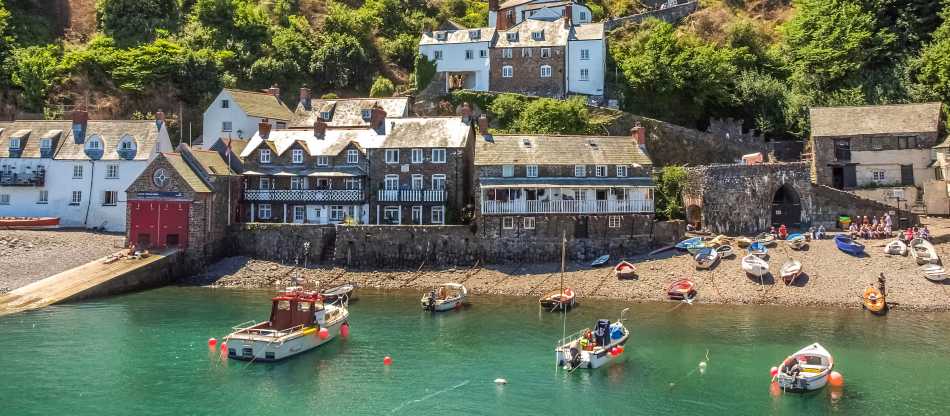
Day 2Day 2: Westward Ho! to Clovelly 18km/11 miles - 5.5 to 6.6hrsThis stage of the South West Coast Path begins with a gentle start along Northam Burrows, a Site of Special Scientific Interest known for its saltmarsh, grazing ponies, and birdlife. From Appledore, the trail begins to undulate more seriously as you head past Buck’s Mills and Peppercombe, where steep wooded valleys—known locally as ‘combes’—cut deep into the coastline. As the path contours above the coast, you eventually descend into Clovelly, a uniquely preserved, traffic-free fishing village clinging to the cliffs. Known for its cobbled high street, donkeys, and sledge-based deliveries, Clovelly has a long history of fishing, smuggling, and shipwrecks. It also inspired Charles Kingsley’s The Water-Babies and has featured in adaptations of Treasure Island and other period dramas. Accommodation: A beautiful cottage on Clovelly’s high street dating from the 14 century (1361) and is still traditionally heated by a solid fuel Aga and wood burners. the front garden is an award winning garden of camellias, roses and various flowers.
This stage of the South West Coast Path begins with a gentle start along Northam Burrows, a Site of Special Scientific Interest known for its saltmarsh, grazing ponies, and birdlife. From Appledore, the trail begins to undulate more seriously as you head past Buck’s Mills and Peppercombe, where steep wooded valleys—known locally as ‘combes’—cut deep into the coastline. As the path contours above the coast, you eventually descend into Clovelly, a uniquely preserved, traffic-free fishing village clinging to the cliffs. Known for its cobbled high street, donkeys, and sledge-based deliveries, Clovelly has a long history of fishing, smuggling, and shipwrecks. It also inspired Charles Kingsley’s The Water-Babies and has featured in adaptations of Treasure Island and other period dramas. Accommodation: A beautiful cottage on Clovelly’s high street dating from the 14 century (1361) and is still traditionally heated by a solid fuel Aga and wood burners. the front garden is an award winning garden of camellias, roses and various flowers.
Day 3Day 3: Clovelly to Hartland Quay 16.5km/10 miles - 6 to 7hrsToday’s walk is challenging yet rewarding, traversing the rugged landscapes of the Hartland Peninsula with steep ascents and descents to the sea and up to clifftops. Beginning in ancient woodland, the trail leads you across patchwork fields and open clifftops with panoramic views. As you approach Hartland Point, a dramatic headland jutting into the Atlantic, you’ll catch sight of Lundy Island on the horizon. Beyond Hartland Point, the scenery changes abruptly—wooded valleys give way to exposed cliffs and a raw, elemental coastline. This is a place shaped by the full force of the sea. The route follows rocky paths above crashing waves, past cascading coastal waterfalls and wind-swept wildflowers. Gulls wheel overhead as you arrive at Hartland Quay, where the spectacularly folded cliffs reveal millions of years of geological history. At low tide, explore the rock pools, flat ledges, and remnants of the original quay structure. Hartland Quay dates back to the late 1500s, when it served as a working harbour for trade across the Bristol Channel—importing coal and lime and exporting local grain. After falling into disrepair in the 19th century, the remaining quayside buildings were transformed into a hotel and pub, offering shelter and sea views in one of the wildest settings on the Devon coast. Accommodation: The Quayside buildings were converted into a hotel and pub at the end of the 19th Century and now has a series of modern rooms in an old-style setting.
Today’s walk is challenging yet rewarding, traversing the rugged landscapes of the Hartland Peninsula with steep ascents and descents to the sea and up to clifftops. Beginning in ancient woodland, the trail leads you across patchwork fields and open clifftops with panoramic views. As you approach Hartland Point, a dramatic headland jutting into the Atlantic, you’ll catch sight of Lundy Island on the horizon. Beyond Hartland Point, the scenery changes abruptly—wooded valleys give way to exposed cliffs and a raw, elemental coastline. This is a place shaped by the full force of the sea. The route follows rocky paths above crashing waves, past cascading coastal waterfalls and wind-swept wildflowers. Gulls wheel overhead as you arrive at Hartland Quay, where the spectacularly folded cliffs reveal millions of years of geological history. At low tide, explore the rock pools, flat ledges, and remnants of the original quay structure. Hartland Quay dates back to the late 1500s, when it served as a working harbour for trade across the Bristol Channel—importing coal and lime and exporting local grain. After falling into disrepair in the 19th century, the remaining quayside buildings were transformed into a hotel and pub, offering shelter and sea views in one of the wildest settings on the Devon coast. Accommodation: The Quayside buildings were converted into a hotel and pub at the end of the 19th Century and now has a series of modern rooms in an old-style setting.
Day 4Day 4: Hartland Quay to Morwenstow 13km/8 miles - 5 to 6hrsToday is another demanding but rewarding section of the trail with sustained climbs and descents through one of the most remote and rugged stretches. You’ll pass Speke’s Mill Mouth Waterfall, the tallest on the SWCP. Though commonly referred to as 15 metres high, the full cascade actually drops 48 metres in three tiers, set in a dramatic hanging valley flanked by sheer cliffs and flower-rich grassland. Watch for seabirds nesting on the cliffs and listen to the roar of the Atlantic as it crashes below. Shortly after, you cross the Devon–Cornwall border and continue on to Morwenstow, a peaceful village with a dark maritime history. Just inland, the village was once a centre for shipwreck rescues, often involving its most famous resident: the poet-priest Rev. Robert Stephen Hawker, writer of Cornwall’s anthem Trelawny and reviver of the Harvest Festival tradition. Visit Hawker’s Hut, the smallest National Trust property, perched on the cliff’s edge with sweeping sea views. Accommodation: a 13th century country pub, riddled with history and intrigue, cosy ensuite rooms. In the Summer, enjoy the outdoor seating in the beer garden with beautiful sea views. Good pub food served.
Today is another demanding but rewarding section of the trail with sustained climbs and descents through one of the most remote and rugged stretches. You’ll pass Speke’s Mill Mouth Waterfall, the tallest on the SWCP. Though commonly referred to as 15 metres high, the full cascade actually drops 48 metres in three tiers, set in a dramatic hanging valley flanked by sheer cliffs and flower-rich grassland. Watch for seabirds nesting on the cliffs and listen to the roar of the Atlantic as it crashes below. Shortly after, you cross the Devon–Cornwall border and continue on to Morwenstow, a peaceful village with a dark maritime history. Just inland, the village was once a centre for shipwreck rescues, often involving its most famous resident: the poet-priest Rev. Robert Stephen Hawker, writer of Cornwall’s anthem Trelawny and reviver of the Harvest Festival tradition. Visit Hawker’s Hut, the smallest National Trust property, perched on the cliff’s edge with sweeping sea views. Accommodation: a 13th century country pub, riddled with history and intrigue, cosy ensuite rooms. In the Summer, enjoy the outdoor seating in the beer garden with beautiful sea views. Good pub food served.
Day 5Day 5: Morwenstow to Bude 11.5km/7 miles - 5.5 to 6.5hrsThis section of the South West Coast Path offers expansive sea views and rugged terrain, especially around Higher Sharpnose Point and Steeple Point, where the narrow clifftop paths provide a thrilling vantage over the Atlantic. The rocky shoreline here was once feared by sailors—over 150 shipwrecks occurred between Morwenstow and Bude, the result of hidden reefs and powerful swells. The route passes waterfalls plunging into secret coves, winds through wooded combes, and gradually softens as you descend into Bude, walking above its broad beach. Bude became a popular Victorian seaside resort, renowned for its golden, shell-rich sands. In the 19th century, sand from the beach was transported inland via the Bude Canal, a six-mile stretch engineered to enrich local farmland. Today, the canal and beach remain key features of this charming North Cornwall coastal town. Accommodation: A B&B close to the seafront.
This section of the South West Coast Path offers expansive sea views and rugged terrain, especially around Higher Sharpnose Point and Steeple Point, where the narrow clifftop paths provide a thrilling vantage over the Atlantic. The rocky shoreline here was once feared by sailors—over 150 shipwrecks occurred between Morwenstow and Bude, the result of hidden reefs and powerful swells. The route passes waterfalls plunging into secret coves, winds through wooded combes, and gradually softens as you descend into Bude, walking above its broad beach. Bude became a popular Victorian seaside resort, renowned for its golden, shell-rich sands. In the 19th century, sand from the beach was transported inland via the Bude Canal, a six-mile stretch engineered to enrich local farmland. Today, the canal and beach remain key features of this charming North Cornwall coastal town. Accommodation: A B&B close to the seafront.
Day 6Day 6: Bude to Crackington Haven 15.5km/9.5 miles - 6 to 7hrsThe day begins with gentle walking along grassy cliff paths behind the beaches between Bude and Widemouth Bay, offering a false sense of ease. Beyond Widemouth, the South West Coast Path becomes more demanding, winding through steep, rugged terrain and plunging into dramatic valleys. One of the most notable is Scrade Valley—one of the deepest and steepest on the Cornish stretch of the trail. High cliffs offer panoramic views over the Atlantic, with the ever-present roar of the sea below. The path here is narrow and uneven, with exposed sections where erosion and strong winds make for exhilarating, if careful, walking. Eventually, the dramatic silhouette of Tintagel Castle comes into view in the distance. Linked to the legend of King Arthur, Tintagel is steeped in myth and mystery. The 13th-century castle was built by Richard, Earl of Cornwall, but the site has much earlier associations, possibly as a Dark Age stronghold. You finish in the quiet cove of Crackington Haven, backed by spectacular folded cliffs that belong to the Crackington Formation—a geologically significant band of Carboniferous shales and sandstone. Once a slate quarrying site, the village now offers a peaceful rest stop with tea rooms and the Coombe Barton Inn, a pub housed in the former home of the quarry manager. Accommodation: A small pub hotel right on the seafront, relax with good food and Cornish keg real ales. There is a traditional menu, sourcing the local, freshest ingredients and there are superb views across the bay or in the glorious summer months outside on the raised decking overlooking the beach. All guestrooms include coffee/tea makers, private bathroom and TV.
The day begins with gentle walking along grassy cliff paths behind the beaches between Bude and Widemouth Bay, offering a false sense of ease. Beyond Widemouth, the South West Coast Path becomes more demanding, winding through steep, rugged terrain and plunging into dramatic valleys. One of the most notable is Scrade Valley—one of the deepest and steepest on the Cornish stretch of the trail. High cliffs offer panoramic views over the Atlantic, with the ever-present roar of the sea below. The path here is narrow and uneven, with exposed sections where erosion and strong winds make for exhilarating, if careful, walking. Eventually, the dramatic silhouette of Tintagel Castle comes into view in the distance. Linked to the legend of King Arthur, Tintagel is steeped in myth and mystery. The 13th-century castle was built by Richard, Earl of Cornwall, but the site has much earlier associations, possibly as a Dark Age stronghold. You finish in the quiet cove of Crackington Haven, backed by spectacular folded cliffs that belong to the Crackington Formation—a geologically significant band of Carboniferous shales and sandstone. Once a slate quarrying site, the village now offers a peaceful rest stop with tea rooms and the Coombe Barton Inn, a pub housed in the former home of the quarry manager. Accommodation: A small pub hotel right on the seafront, relax with good food and Cornish keg real ales. There is a traditional menu, sourcing the local, freshest ingredients and there are superb views across the bay or in the glorious summer months outside on the raised decking overlooking the beach. All guestrooms include coffee/tea makers, private bathroom and TV.
Day 7Day 7: Crackington Haven to Tintagel 19km/12 miles - 6 to 7hrsToday’s route offers some of the most dramatic geology on the South West Coast Path, with towering cliffs, deep valleys, and spectacular views over the Atlantic. Expect a series of steep climbs and descents, including a hike up to High Cliff—Cornwall’s highest sea cliff at 223 metres. Look out for peregrine falcons, Soay sheep, and feral goats, whose grazing encourages a rich variety of coastal wildflowers. You’ll also pass the Pentargon Waterfall, which plunges from a hanging valley onto the rocks below. A highlight of the day is the descent into Boscastle, a picturesque fishing village tucked into a narrow, steep-sided inlet with an ancient harbour barely visible from the sea. Further along the trail lies Tintagel, steeped in both legend and archaeology. Known as the legendary birthplace of King Arthur, the clifftop castle site has yielded more imported post-Roman pottery than anywhere else in Britain, suggesting it was once a place of great significance. The ruins seen today mostly date to the 13th century, but the headland was once a Roman settlement and a Celtic stronghold. Accommodation: A guesthouse near Tintagel Castle.
Today’s route offers some of the most dramatic geology on the South West Coast Path, with towering cliffs, deep valleys, and spectacular views over the Atlantic. Expect a series of steep climbs and descents, including a hike up to High Cliff—Cornwall’s highest sea cliff at 223 metres. Look out for peregrine falcons, Soay sheep, and feral goats, whose grazing encourages a rich variety of coastal wildflowers. You’ll also pass the Pentargon Waterfall, which plunges from a hanging valley onto the rocks below. A highlight of the day is the descent into Boscastle, a picturesque fishing village tucked into a narrow, steep-sided inlet with an ancient harbour barely visible from the sea. Further along the trail lies Tintagel, steeped in both legend and archaeology. Known as the legendary birthplace of King Arthur, the clifftop castle site has yielded more imported post-Roman pottery than anywhere else in Britain, suggesting it was once a place of great significance. The ruins seen today mostly date to the 13th century, but the headland was once a Roman settlement and a Celtic stronghold. Accommodation: A guesthouse near Tintagel Castle.
Day 8Day 8: Tintagel to Port Isaac 14.5km/9 miles - 6 to 7hrsAfter a relatively gentle start from Tintagel, the walk soon becomes a more strenuous trek toward Port Isaac. The section between Trebarwith Strand and Port Isaac involves steep descents into lush valleys followed by tough climbs back up to the clifftops. This part of the trail is set within a designated Area of Outstanding Natural Beauty (AONB), once a hub for slate mining, fishing, and processing. As you approach Port Isaac, you'll be greeted by its picturesque winding streets, which have long drawn visitors, particularly after the popularity of the BBC Doc Martin TV series. The name 'Port Isaac' originates from the Cornish "Porthysek," meaning "corn port," reflecting its early trade in grain. However, the village truly flourished during the Tudor period when pilchard fishing became a vital industry for the local economy. Accommodation: An inn dating to 1527, once a a smugglers' hideaway and a ships chandlery, today it operates as a harbourside café located on an amazing outdoor terrace overlooking the port and a Bar & Restaurant.
After a relatively gentle start from Tintagel, the walk soon becomes a more strenuous trek toward Port Isaac. The section between Trebarwith Strand and Port Isaac involves steep descents into lush valleys followed by tough climbs back up to the clifftops. This part of the trail is set within a designated Area of Outstanding Natural Beauty (AONB), once a hub for slate mining, fishing, and processing. As you approach Port Isaac, you'll be greeted by its picturesque winding streets, which have long drawn visitors, particularly after the popularity of the BBC Doc Martin TV series. The name 'Port Isaac' originates from the Cornish "Porthysek," meaning "corn port," reflecting its early trade in grain. However, the village truly flourished during the Tudor period when pilchard fishing became a vital industry for the local economy. Accommodation: An inn dating to 1527, once a a smugglers' hideaway and a ships chandlery, today it operates as a harbourside café located on an amazing outdoor terrace overlooking the port and a Bar & Restaurant.
Day 9Day 9: Port Isaac to Padstow 19km/12 mile- 5.5 to 6.5hrsThis challenging yet rewarding section marks the final stretch of your Cornish walking adventure. Begin with spectacular views from Lobber Point, where you can look back over Port Isaac, with Tintagel Church and Castle in the distance. You'll pass the inlet of Pine Haven and the historic promontory of The Rumps, before reaching Portquin, a village with a haunting history. Known as "the village that died," it was abandoned after a tragic event in the 19th century, when all the men were lost at sea during a fishing expedition. The walk continues with tough climbs and descents, particularly through small valleys and exposed headlands. After reaching Polzeath, the terrain eases, and you can enjoy a gentler walk before taking the ferry into Padstow. This charming fishing town, famous for Rick Stein’s renowned seafood restaurant, sits at the mouth of a bay guarded by the perilous "Doombar" sandbar, notorious for shipwrecks at certain tides. Accommodation: A historic guesthouse close to the harbour.
This challenging yet rewarding section marks the final stretch of your Cornish walking adventure. Begin with spectacular views from Lobber Point, where you can look back over Port Isaac, with Tintagel Church and Castle in the distance. You'll pass the inlet of Pine Haven and the historic promontory of The Rumps, before reaching Portquin, a village with a haunting history. Known as "the village that died," it was abandoned after a tragic event in the 19th century, when all the men were lost at sea during a fishing expedition. The walk continues with tough climbs and descents, particularly through small valleys and exposed headlands. After reaching Polzeath, the terrain eases, and you can enjoy a gentler walk before taking the ferry into Padstow. This charming fishing town, famous for Rick Stein’s renowned seafood restaurant, sits at the mouth of a bay guarded by the perilous "Doombar" sandbar, notorious for shipwrecks at certain tides. Accommodation: A historic guesthouse close to the harbour.
Day 10Day 10: Arrangements end after breakfastDepart Padstow after breakfast. To travel from Padstow to other parts of the UK by bus or train, take a local bus to Bodmin Parkway Station, about 25 minutes away, where you can catch trains to major cities like London, Exeter, and Plymouth. Alternatively, buses from Padstow connect to nearby towns such as Newquay and Truro, where you can access National Express coaches for long-distance travel to destinations across the UK. Speak to a member of our team if you'd like to extend your stay in this foodie Cornish town.
Depart Padstow after breakfast. To travel from Padstow to other parts of the UK by bus or train, take a local bus to Bodmin Parkway Station, about 25 minutes away, where you can catch trains to major cities like London, Exeter, and Plymouth. Alternatively, buses from Padstow connect to nearby towns such as Newquay and Truro, where you can access National Express coaches for long-distance travel to destinations across the UK. Speak to a member of our team if you'd like to extend your stay in this foodie Cornish town.