Explore Northern France & Belgium by bike on the historic, self-guided Western Front Cycle Tour. Ride from Amiens to Ypres on this affordable, 8-day bike trip.
At a glance
Duration
8 days
Route
→
Countries
France
Activity level
moderate
Style
Culture & History, Cycling
Group size
Ask
Flights
Not included
Solo travellers
Ask an agent
Day by day
Your journey through
France
Showing Days 1-7
8-day itinerary
Day 1Day 1: Arrive AmiensOn arrival in Amiens make your way to your hotel which is located in the centre of town near the Cathedral. The Cathedral is the largest example of Gothic architecture in France and is a UNESCO World Heritage listed site. It boasts a soaring nave and its said could easily accommodate the Notre Dame twice over. Miraculously, the Cathedral survived WWI. There are a number of commemorative plaques, in memory of soldiers from the Allied Front. Amiens was home to Jules Verne for a number of years and it was here that he wrote most of his novels. Take time to stroll along the canal path before you begin your cycle tour.
On arrival in Amiens make your way to your hotel which is located in the centre of town near the Cathedral. The Cathedral is the largest example of Gothic architecture in France and is a UNESCO World Heritage listed site. It boasts a soaring nave and its said could easily accommodate the Notre Dame twice over. Miraculously, the Cathedral survived WWI. There are a number of commemorative plaques, in memory of soldiers from the Allied Front. Amiens was home to Jules Verne for a number of years and it was here that he wrote most of his novels. Take time to stroll along the canal path before you begin your cycle tour.
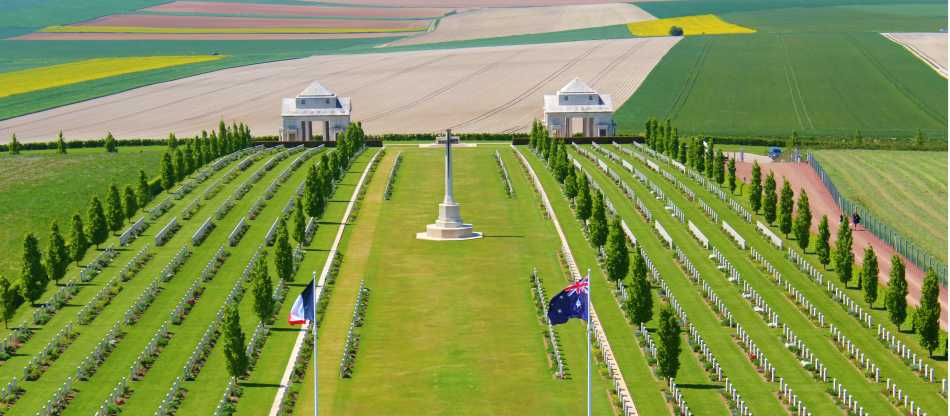
Day 2Day 2: Somme River cycle to Villers BretonneauxThe ride begins eastwards following the river Somme and after about 19km, you arrive in Villers Bretonneaux. It was here between 24 and 26 April 1918 that the Australian expeditionary army corps successfully stopped the advancing German troops and, as a consequence, prevented the city of Amiens from being taken. The Australian National Memorial and the Franco-Australian Museum, within the Victoria School, offer a fascinating and detailed insight into these events. Continuing eastwards, you cross the Hamel battlefield to gain access to the other side of the River Somme, at Cerisy, then enjoy magnificent river views along the road leading to Albert. The town of Albert was the epicentre of the great battle of the Somme and was also the principal industrial town in the Ancre Valley. The Somme Museum, established within an anti-aircraft underground shelter, retraces military life during the First World War.
The ride begins eastwards following the river Somme and after about 19km, you arrive in Villers Bretonneaux. It was here between 24 and 26 April 1918 that the Australian expeditionary army corps successfully stopped the advancing German troops and, as a consequence, prevented the city of Amiens from being taken. The Australian National Memorial and the Franco-Australian Museum, within the Victoria School, offer a fascinating and detailed insight into these events. Continuing eastwards, you cross the Hamel battlefield to gain access to the other side of the River Somme, at Cerisy, then enjoy magnificent river views along the road leading to Albert. The town of Albert was the epicentre of the great battle of the Somme and was also the principal industrial town in the Ancre Valley. The Somme Museum, established within an anti-aircraft underground shelter, retraces military life during the First World War.
Day 3Day 3: Cycle via Pozieres to Arras (45 or 67km/28 or 41.6mi)Following the main road out of town, you head north to the Ancre Valley before climbing towards Thiépval Ridge. The first large offensive was launched on 1 July 1916 here, involving 20,000 men from the British Reserve Army and was known as 'the bloodiest day in British military history'. Thiépval was liberated three months later, on 27 September. You pass the Belfast Tower, erected in 1921 in memory of the Ulster Battalion which so courageously fought that day. After crossing Ancre, arrive at the Beaumont-Hamel Newfoundland Memorial, dedicated to the Newfoundland Regiment which was all but annihilated in the space of 30 minutes after the German soldiers opened fire. A little further on, arrive at the German cemetery Fricourt and two memorial sites, one dedicated to the South African regiment and known as Delville Wood, the other dedicated to the New Zealand division called Longueval. The cycle route then takes you to the village of Pozieres, where the Australian regiment, completely exhausted by relentless artillery attacks, was eventually relieved by the Canadians. The names of over 14,000 casualties are engraved on the cemetery walls here. Leave the Somme department and cycle for a further 20km through countryside before reaching Arras, the Artois capital. With its Flemish Baroque style, Arras has a long and established reputation for superb draperies and tapestries, and the city's wealth and influence is evident. With architecture dating from the Flemish Baroque period through to the Art Deco style, Arras will charm you. Two World Heritage listed sites, the Belfry and Vauban's Citadel, warrant a visit, as do the 'Boves', underground passages dating from medieval times and expanded by the New Zealand Tunnelling Company. Robespierre, the influential figure of the French Revolution, was born in Arras. In the evening, you can relax at one of the cafes in the celebrated Place des Heros. Overnight Arras
Following the main road out of town, you head north to the Ancre Valley before climbing towards Thiépval Ridge. The first large offensive was launched on 1 July 1916 here, involving 20,000 men from the British Reserve Army and was known as 'the bloodiest day in British military history'. Thiépval was liberated three months later, on 27 September. You pass the Belfast Tower, erected in 1921 in memory of the Ulster Battalion which so courageously fought that day. After crossing Ancre, arrive at the Beaumont-Hamel Newfoundland Memorial, dedicated to the Newfoundland Regiment which was all but annihilated in the space of 30 minutes after the German soldiers opened fire. A little further on, arrive at the German cemetery Fricourt and two memorial sites, one dedicated to the South African regiment and known as Delville Wood, the other dedicated to the New Zealand division called Longueval. The cycle route then takes you to the village of Pozieres, where the Australian regiment, completely exhausted by relentless artillery attacks, was eventually relieved by the Canadians. The names of over 14,000 casualties are engraved on the cemetery walls here. Leave the Somme department and cycle for a further 20km through countryside before reaching Arras, the Artois capital. With its Flemish Baroque style, Arras has a long and established reputation for superb draperies and tapestries, and the city's wealth and influence is evident. With architecture dating from the Flemish Baroque period through to the Art Deco style, Arras will charm you. Two World Heritage listed sites, the Belfry and Vauban's Citadel, warrant a visit, as do the 'Boves', underground passages dating from medieval times and expanded by the New Zealand Tunnelling Company. Robespierre, the influential figure of the French Revolution, was born in Arras. In the evening, you can relax at one of the cafes in the celebrated Place des Heros. Overnight Arras
Day 4Day 4: Along the River Scarpe to Vimy…Following the River Scarpe, you then head north for about 20km/12.5mi until you reach Vimy. On 17 April 1917, this large park became the centrepiece of a ferocious battle between the German army and Canadian troops, the latter losing more than 11,000 soldiers. The impressive Canadian National Vimy Memorial was built on the Vimy Ridge and commemorates those who lost their lives here. You can pause at Souchez village before climbing Lorette's Hill, where in May 1915 French and German troops fought to gain control of Artois. The cemetery Notre Dame de Lorette, where 40,000 soldiers found their final resting place, is considered the most important French military cemetery of today. Continuing north, you cross a section of mining area and arrive in Béthune, where you spend the night. Historically, Bethune has always been considered a bourgeois town, accumulating wealth from neighbouring agricultural land, a prolific textile industry dating back to the Middle Ages and a thriving mechanical/chemical industry. Although Bethune managed to escape German occupation, the town centre was badly bombed in May 1918 and with the exception of the belfry, was almost entirely destroyed. Since 1964, the town has been twinned with Hastings in England, where another great battle took place and a certain William the Conqueror was crowned the new King of England. Overnight Béthune Note: you will stay in Gosnay (46km) tonight if booking with the upgrade option.
Following the River Scarpe, you then head north for about 20km/12.5mi until you reach Vimy. On 17 April 1917, this large park became the centrepiece of a ferocious battle between the German army and Canadian troops, the latter losing more than 11,000 soldiers. The impressive Canadian National Vimy Memorial was built on the Vimy Ridge and commemorates those who lost their lives here. You can pause at Souchez village before climbing Lorette's Hill, where in May 1915 French and German troops fought to gain control of Artois. The cemetery Notre Dame de Lorette, where 40,000 soldiers found their final resting place, is considered the most important French military cemetery of today. Continuing north, you cross a section of mining area and arrive in Béthune, where you spend the night. Historically, Bethune has always been considered a bourgeois town, accumulating wealth from neighbouring agricultural land, a prolific textile industry dating back to the Middle Ages and a thriving mechanical/chemical industry. Although Bethune managed to escape German occupation, the town centre was badly bombed in May 1918 and with the exception of the belfry, was almost entirely destroyed. Since 1964, the town has been twinned with Hastings in England, where another great battle took place and a certain William the Conqueror was crowned the new King of England. Overnight Béthune Note: you will stay in Gosnay (46km) tonight if booking with the upgrade option.
Day 5Day 5: Cycle via Fromelles (longer route)…Welcome to Flanders, or 'the flat land': the title of one of Jacques Brel's songs, where he describes the flat landscape, void of mountains. Gastronomically, the region's specialties reflect the celebrated reputation of its people - their warmth! Delight in sampling regional dishes such as Carbonade Flamande, Maroilles, Welsh Potjevleesch or Waterzooi, all accompanied by freshly made chips and quality beer from one of the neighbouring abbeys. Flanders was formerly one of the richest and most coveted of French provinces, and also one of the most densely populated. It played a significant role in the French Industrial Revolution. If you opt for the longer of the cycle routes today, you will arrive at Fromelles, a small village which became the centre of combat between the Commonwealth (principally Australians) and the Germans. On 19 and 20 July 1916, around 8,500 soldiers were killed. Rejoining the shorter route, you head towards Bailleul, the capital of the 'Monts de Flandres', a series of small hills which rise to about 160m. From the top there are magnificent views of the surrounding countryside. You can take time out to relax in one of the region's typical inns. Also worthy of a visit is the 'Abbaye du Mont des Cats', where you can delight in sampling local cheese and beer produced by the local Trappist monks. The Franco-American writer Marguerite Yourcenar grew up in this charming, picturesque region. You then cross into Belgium and head towards Ypres, where you will spend the next two nights. *If your previous night was in Gosnay add an additional 6km/3.7mi to those shown above.
Welcome to Flanders, or 'the flat land': the title of one of Jacques Brel's songs, where he describes the flat landscape, void of mountains. Gastronomically, the region's specialties reflect the celebrated reputation of its people - their warmth! Delight in sampling regional dishes such as Carbonade Flamande, Maroilles, Welsh Potjevleesch or Waterzooi, all accompanied by freshly made chips and quality beer from one of the neighbouring abbeys. Flanders was formerly one of the richest and most coveted of French provinces, and also one of the most densely populated. It played a significant role in the French Industrial Revolution. If you opt for the longer of the cycle routes today, you will arrive at Fromelles, a small village which became the centre of combat between the Commonwealth (principally Australians) and the Germans. On 19 and 20 July 1916, around 8,500 soldiers were killed. Rejoining the shorter route, you head towards Bailleul, the capital of the 'Monts de Flandres', a series of small hills which rise to about 160m. From the top there are magnificent views of the surrounding countryside. You can take time out to relax in one of the region's typical inns. Also worthy of a visit is the 'Abbaye du Mont des Cats', where you can delight in sampling local cheese and beer produced by the local Trappist monks. The Franco-American writer Marguerite Yourcenar grew up in this charming, picturesque region. You then cross into Belgium and head towards Ypres, where you will spend the next two nights. *If your previous night was in Gosnay add an additional 6km/3.7mi to those shown above.
Day 6Day 6: Loop cycle retracing historic First World…In October 1914, the Western Front battle lines halted several kilometres from the town of Ypres and formed a salient along the German lines. This wealthy Flemish town witnessed five different battles, where soldiers from all corners of the world joined forces to take part in the combat. Today's cycle route retraces these historic events from Zonnebeke to Langemark Poelkapelle and including Passchendaele. More than 300,000 allied troops, including 250,000 from the Commonwealth, died during these ferocious battles and there are more than 170 cemeteries in the surrounding countryside. Returning to Ypres, it is difficult to imagine that this medieval town was almost entirely destroyed at the end of the First World War. Its prosperity developed during the Middle Ages, when it was known as the 'Craftsman's Textile Capital'. The Tapestry/Textile Market Hall, one of the largest Gothic-style buildings in Europe, was unfortunately destroyed during the German air raids but has been restored to its former glory. A visit to the museum 'In Flanders Fields' allows visitors to retrace the life of a soldier or a civilian during the war. Ypres also has an abundance of fine chocolate producers as well as several delicious local specialties: waffles, Tapjesvlees, Patte de Chat and Cuberdon. At 8pm at the Menin Gate (la Porte de Menin, or in Dutch 'Menenpoort'), there is an event that should not be missed: every day since 1928, buglers sound the 'Last Post' in memory of the Commonwealth troops. Overnight Ypres
In October 1914, the Western Front battle lines halted several kilometres from the town of Ypres and formed a salient along the German lines. This wealthy Flemish town witnessed five different battles, where soldiers from all corners of the world joined forces to take part in the combat. Today's cycle route retraces these historic events from Zonnebeke to Langemark Poelkapelle and including Passchendaele. More than 300,000 allied troops, including 250,000 from the Commonwealth, died during these ferocious battles and there are more than 170 cemeteries in the surrounding countryside. Returning to Ypres, it is difficult to imagine that this medieval town was almost entirely destroyed at the end of the First World War. Its prosperity developed during the Middle Ages, when it was known as the 'Craftsman's Textile Capital'. The Tapestry/Textile Market Hall, one of the largest Gothic-style buildings in Europe, was unfortunately destroyed during the German air raids but has been restored to its former glory. A visit to the museum 'In Flanders Fields' allows visitors to retrace the life of a soldier or a civilian during the war. Ypres also has an abundance of fine chocolate producers as well as several delicious local specialties: waffles, Tapjesvlees, Patte de Chat and Cuberdon. At 8pm at the Menin Gate (la Porte de Menin, or in Dutch 'Menenpoort'), there is an event that should not be missed: every day since 1928, buglers sound the 'Last Post' in memory of the Commonwealth troops. Overnight Ypres
Day 7Day 7: Cycle through flat farmland to Bruges (61km/37.6mi)Enjoy a hearty Flemish breakfast before leaving the battlefields behind. Cycle through flat farming land alongside small water canals on a network of bike paths away from traffic as you make your way to Bruges. The capital of West Flanders, Bruges was one of the great North European trading ports in late medieval times and today it's one of Europe's best preserved medieval cities. Enjoy exploring its canals, cobbled streets, market squares, historical churches and old almshouses. Overnight Bruges
Enjoy a hearty Flemish breakfast before leaving the battlefields behind. Cycle through flat farming land alongside small water canals on a network of bike paths away from traffic as you make your way to Bruges. The capital of West Flanders, Bruges was one of the great North European trading ports in late medieval times and today it's one of Europe's best preserved medieval cities. Enjoy exploring its canals, cobbled streets, market squares, historical churches and old almshouses. Overnight Bruges
TripFinder compares the available catalog facts and Brandi Leanna can handle the booking — and you pay the same as booking UTracks direct, never more, because the operator pays our commission. You travel under the operator's terms; final price and availability are confirmed before purchase.